Tài Liệu Học Tập
No Result
View All Result
  • Đề Thi
  • Lớp 12
    • Lịch Sử Lớp 12
    • Địa Lí Lớp 12
    • Ngữ Văn Lớp 12
    • GD KTPL Lớp 12
    • Toán Lớp 12
    • Tiếng Anh Lớp 12
    • Hóa Học Lớp 12
    • Sinh Học Lớp 12
    • Vật Lí Lớp 12
  • Lớp 11
    • Toán Lớp 11
    • Ngữ Văn Lớp 11
    • Tiếng Anh Lớp 11
    • Hóa Học Lớp 11
    • Sinh Học Lớp 11
    • Vật Lí Lớp 11
    • Lịch Sử Lớp 11
    • Địa Lí Lớp 11
    • GDCD Lớp 11
  • Lớp 10
    • Toán Lớp 10
    • Ngữ Văn Lớp 10
    • Tiếng Anh Lớp 10
    • Hóa Học Lớp 10
    • Sinh Học Lớp 10
    • Vật Lí Lớp 10
    • Lịch Sử Lớp 10
    • Địa Lí Lớp 10
    • GDKTPL Lớp 10
    • Công nghệ lớp 10
    • Tin Học Lớp 10
  • Lớp 9
    • Toán Lớp 9
    • Ngữ Văn Lớp 9
    • Tiếng Anh Lớp 9
    • Lịch sử và địa lý lớp 9
    • Khoa Học Tự Nhiên Lớp 9
    • GDCD Lớp 9
  • Lớp 8
    • Toán Lớp 8
    • Ngữ Văn Lớp 8
    • Tiếng Anh Lớp 8
    • Lịch sử và địa lý lớp 8
    • Khoa Học Tự Nhiên Lớp 8
    • GDCD 8
  • Lớp 7
    • Toán Lớp 7
    • Văn Lớp 7
    • Tiếng Anh Lớp 7
    • Lịch Sử Và Địa Lí Lớp 7
    • Khoa Học Tự Nhiên Lớp 7
  • Lớp 6
    • Toán Lớp 6
    • Văn Lớp 6
    • Tiếng Anh lớp 6
    • Lịch Sử và Địa Lí Lớp 6
    • Khoa Học Tự Nhiên lớp 6
  • Lớp 5
    • Toán lớp 5
    • Tiếng Việt Lớp 5
    • Tiếng Anh Lớp 5
    • Lịch Sử và Địa Lí Lớp 5
  • Lớp 4
    • Toán lớp 4
    • Tiếng Việt Lớp 4
    • Tiếng Anh Lớp 4
    • Lịch Sử và Địa Lí Lớp 4
  • Lớp 3
    • Toán lớp 3
    • Tiếng Anh Lớp 3
    • Tiếng Việt Lớp 3
  • Mẹo Hay
  • Tin tức
  • Liên Hệ
Tài Liệu Học Tập
No Result
View All Result
Home Văn học

Đề số 7 – Đề kiểm tra học kì 1 (Đề thi học kì 1) – Địa lí 10

by Tranducdoan
09/06/2026
in Văn học
0
Đánh giá bài viết

Đề bài

I. TRẮC NGHIỆM (4,0 điểm)

Câu 1: Nguyên nhân chủ yếu làm cho các đai khí áp không liên tục mà bị chia cắt thành từng khu khí áp riêng biệt là:

A. sự phân bố xen kẽ giữa lục địa và đại dương.

B. tác động của hoàn lưu khí quyển.

C. hoạt động của dải hội tụ nhiệt đới.

D. Do ảnh hưởng của các dòng biển.

Câu 2: Đối với đất địa hình không đóng vai trò trong việc:

A. Làm tăng sự bồi tụ

B. Làm tăng sự xói mòn

C. Thay đổi thành phần cơ giới của đất

D. Tạo ra các vành đai đất

Câu 3: Tính chất nào sau đây không phải của các hành tinh:

A. Là khối vật chất trong Vũ Trụ.

B. tự phát ra ánh sáng.

C. Không tự phát sáng.

D. Chuyển động quanh Mặt Trời.

Câu 4: Gió mùa là loại gió trong một năm có:

A. Hướng gió thay đổi không theo mùa

B. Mùa hè từ lục địa ra, mùa đông từ biển thổi vào

C. Hai mùa thổi cùng hướng nhau

D. Hai mùa thổi ngược hướng nhau

Câu 5: Trên Trái Đất nơi có lượng mưa nhiều nhất là vùng

A. gần 2 cực.

B. chí tuyến Bắc và chí tuyến Nam.

C. ôn đới.

D. xích đạo.

Câu 6: Đặc điểm nào sau đây không thuộc mảng kiến tạo:

A. Hiện nay đã ngừng dịch chuyển.

B. Gồm bộ phận lục địa và cả vùng lớn của đáy đại dương.

C. Một bộ phận của lớp vỏ Trái Đất bị tách dãn do các đứt gãy.

D. Dịch chuyển được là nhờ các dòng đối lưu vật chất trong lớp Manti trên.

Câu 7: Sinh quyển là

A. Là quyển của Trái Đất, trong đó có thực vật và động vật sống.

B. Là một quyển của Trái Đất, trong đó có toàn bộ sinh vật sống.

C. Nơi sinh sống của toàn bộ sinh vật.

D. Nơi sinh sống của thực vật và động vật.

Câu 8: Sinh ra ngoại lực chủ yếu từ nguồn năng lượng:

A. Thủy triều

B. Bức xạ Mặt Trời

C. Gió

D. Động đất và núi lửa

Câu 9: Khu vực có nhiệt độ cao nhất bề mặt Trái Đất, ở:

A. Chí tuyến

B. Xích đạo

C. Lục địa chí tuyến

D. Lục địa và xích đạo

Câu 10: Khi khu vực giờ gốc là 5 giờ sáng thì ở Việt Nam (múi giờ số 7) lúc đó là:

A. 7 giờ sáng B. 7 giờ tối

C. 12 giờ trưa D. 12 giờ đêm

Câu 11: Hiện tượng Mặt Trời lên thiên đỉnh mỗi năm chỉ một lần ở:

A. Cực Bắc và Nam

B. Chí tuyến Bắc và Nam

C. Ngoại chí tuyến

D. Nội chí tuyến

Câu 12: Từ trong ra ngoài, cấu tạo của Trái Đất theo thứ tự các lớp:

A. Nhân, bao Manti, vỏ lục địa và vỏ đại dương.

B. Nhân, bao Manti, vỏ đại dương, vỏ lục địa.

C. Nhân, vỏ lục địa, vỏ đại dương, bao Manti.

D. Nhân, bao Manti, vỏ lục địa, vỏ đại dương.

Câu 13: Nước sông chảy nhanh hay chậm phụ thuộc vào

A. Độ dốc của mặt nước ở nguồn sông

B. Độ dốc của mặt nước ở cửa sông

C. Độ dốc của đáy sông

D. Độ dốc và độ rộng của lòng sông

Câu 14: Địa hào được hình thành do:

A. Các lớp đá có bộ phận trồi lên.

B. Các lớp đá uốn thành nếp.

C. Các lớp đá bị nén ép.

D. Các lớp đá có bộ phận bị sụt xuống.

Câu 15: Phương pháp chấm điểm biểu hiện được:

A. Sự phân bố không đồng đều của đối tượng địa lí.

B. Sự phân bố liên tục của đối tượng địa lí.

C. Cơ cấu của đối tượng địa lí.

D. Sự phân bố đồng đều của đối tượng địa lí.

Câu 16: Đồng bằng châu thổ là dạng địa hình được hình thành bởi quá trình:

A. Tích tụ B. Xâm thực

C. Vận chuyển D. Bào mòn

II. TỰ LUẬN (6,0 điểm)

Câu 1: (1,0 điểm)

Trình bày hệ quả của chuyển động tự quay quanh trục của Trái Đất: sự luân phiên ngày và đêm.

Câu 2: (1,0 điểm)

Nêu ý nghĩa thực tiễn của quy luật thống nhất và hoàn chỉnh của lớp vỏ địa lí.

Câu 3: (4,0 điểm)

Cho bảng số liệu sau:

SẢN LƯỢNG LƯƠNG THỰC CỦA THẾ GIỚI, GIAI ĐOẠN 1990-2008

Đơn vị: Triệu tấn

a) Vẽ biểu đồ thể hiện sản lượng lương thực của thế giới, giai đoạn 1990-2008

b) Nhận xét sản lượng lương thực của thế giới, giai đoạn 1990-2008.

Lời giải chi tiết

I. TRẮC NGHIỆM

1 2 3 4 5 6 A C B D D A 7 8 9 10 11 12 B B C C B A 13 14 15 16 D D A A

II. TỰ LUẬN

Câu 1:

Trình bày hệ quả của chuyển động tự quay quanh trục của Trái Đất: sự luân phiên ngày và đêm.

– Do Trái Đất hình cầu nên vào 1 thời điểm Mặt Trời chỉ chiếu sáng được 1 nửa; nửa kia không được chiếu sáng, sinh ra hiện tượng ngày đêm

– Do Trái Đất tự quay quanh trục (thời gian tự quay quanh trục xấp xỉ 24h) nên mọi nơi trên bề mặt Trái Đất lần lượt được Mặt Trời chiếu sáng rồi lại chìm vào bóng tối, tao nên hiện tượng luân phiên ngày đêm

Câu 2:

Quy luật thống nhất và hoàn chỉnh của lớp vỏ địa lí là quy luật về mối quan hệ quy định lẫn nhau giữa các thành phần của toàn bộ cũng như của mỗi bộ phận lãnh thổ trong lớp vỏ địa lí

Quy luật thống nhất và hoàn chỉnh của lớp vỏ địa lí cho chúng ta thấy sự cần thiết phải nghiên cứu kĩ càng và toàn diện điều kiện địa lí của bất kì lãnh thổ nào trước khi sử dụng chúng.

Ví dụ: khi xây dựng đập thủy điện, cần tính toán, đánh giá tác động tới các thành phần tự nhiên trong quá trình xây dựng thủy điện. Do xây dựng đập thủy điện cần phá hủy diện tích lớn rừng, làm thay đổi dòng chảy, thay đổi hàm lượng phù sa trong dòng sông. Như vậy con người đã can thiệp vào mối liên hệ chặt chẽ giữa các thành phần của tự nhiên, điều đó có thể dẫn tới những hậu quả trái ý muốn của con người. Như, vào mùa lũ, khi lưu lượng nước sông đổ về đập thủy điện quá lớn, các nhà máy buộc phải xả lũ để giữ an toàn đập, làm cho hạ lưu đập bị ngập lụt nghiêm trọng hơn mức bình thường. Việc xây dựng đập thủy điện làm giảm lưu lượng nước trung bình về hạ lưu, giảm phù sa, gây thiếu hụt bồi tích ở hạ lưu sông và có thể dẫn tới sạt lở bờ sông

Câu 3

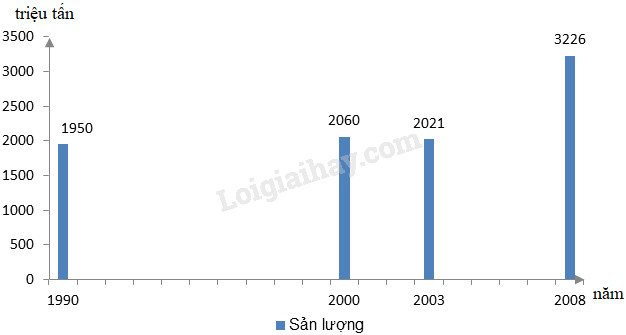
Vẽ biểu đồ thể hiện sản lượng lương thực của thế giới, giai đoạn 1990-2008

– Biểu đồ thích hợp nhất thể hiện sản lượng lương thực của thế giới, giai đoạn 1990-2008 là biểu đồ cột đơn
dac diem nao sau day khong phai cua lop vo dia ly

Biểu đồ thể hiện sản lượng lương thực của thế giới, giai đoạn 1990-2008

Đơn vị: triệu tấn

Chú ý: biểu đồ dạng cột, có đầy đủ chú giải, đơn vị trục tung, trục hoành, đơn vị biểu đồ; khoảng cách năm hợp lí

b) Nhận xét sản lượng lương thực của thế giới, giai đoạn 1990-2008.

– Giai đoạn 1990-2008, sản lượng lương thực thế giới có xu hướng tăng, tăng từ 1950 triệu tấn lên 3226 triệu tấn, tăng 1276 triệu tấn, tăng 1,65 lần, trung bình mỗi năm tăng 70,9 triệu tấn

– Giai đoạn 2000-2003, sản lượng lương thực giảm nhẹ từ 2060 triệu tấn xuống 2021triệu tấn, giảm 39 triệu tấn; sau đó giai đoạn 2003 – 2008 sản lượng lương thực thế giới có xu hướng tăng trở lại và tăng nhanh; tăng từ 2021 triệu tấn lên 3226 triệu tấn; tăng 1,59 lần, trung bình mỗi năm tăng 241 triệu tấn.

Xem thêm: Lời giải chi tiết Đề kiểm tra học kì 1 (Đề thi học kì 1) môn Địa lí 10 tại Tuyensinh247.com

Loigiaihay.com

Previous Post

Next Post

6 Lessons to Remember When Someone Judges or Criticizes You By Angela Lois “Every judgment, all of them, point back to a judgment we hold against ourselves.” ~Lynne Forrest I sat across from my good friend Anna over a cup of coffee. We had been having issues in our friendship and had finally gotten together to discuss them. I’m not a fan of conflict and call myself a “recovering people pleaser,” so I was very nervous. I noticed immediately that the conversation didn’t seem to be going very well. I addressed my issues concerning our friendship and tried hard to own my part. But Anna kept saying things like, “There are things that you do that really bother me as well, but I don’t say anything about saying them.” After hearing a variation of this phrase for a third time, I asked what she was talking about. She had never addressed any of these issues with me. She took a deep breath and said, “Angela, I don’t think your relationship with your higher power is very strong. Also, you know those Facebook posts you write about peace and mindfulness? I don’t see that reflected in your personality. One more thing: Your relationship with your mother seems poor, and I think that’s why you are emotionally needy.” I stared at her in absolute shock. I felt like I was punched in the face. The worst part is this girl was a very genuine person, so the fact that she saw these qualities in me broke my heart. My spirituality and my sense of peace are things I have been cultivating intensely since I was sixteen. Here I was sitting across from this girl, who’s supposedly my best friend, and she doesn’t even see these positive qualities in me. I was devastated. I walked out of that get-together saying I needed some time to be alone and process. I was deeply hurt. Before we met, I had envisioned us having a positive conversation, fixing our relationship, and spending the rest of the coffee date laughing. Instead, I left feeling like someone had ripped out my heart and like I was going to throw up. It’s been quite a process wrestling with this event, and I’ve had the opportunity to learn (and relearn) some amazing lessons. 1. Someone’s criticisms and judgments aren’t the problem. Believing them is the problem. I’ve been criticized before, but these judgments particularly crushed me. I couldn’t stop crying. I felt exposed. I realized the reason I was having such a hard time with what she had said was because there’s a part of me that believes her judgments about me. For example, if she had told me I was mean, I would have shrugged it off, because I do not believe that about myself. On the other hand, I do have insecurities concerning my spirituality and sense of peace in the world. While I try to cultivate both of these aspects in my personal life, I’m not perfect. I struggle just like everyone else. Once I realized I was upset because I believed her accusations to be true, I could stop blaming her. I was in pain because I was torturing myself with these beliefs and blindly believing them. 2. When someone shows us how we’re out of alignment with ourselves, we have an opportunity to change our beliefs. I’ve seen again and again that the world is a mirror. When we think a thought and believe it, the world will give us an example to prove that thought to be true. Anna showed me the part of me that believed these insecurities. She gave me the beautiful gift of questioning if I wanted to hold onto these beliefs. Remember, we do not have to believe our thoughts. I heard an example about thoughts once that has stuck with me. Thoughts are like cars zooming on a highway. The highway represents the mind. We get to decide which car we want to jump into. Do we want to jump into the car and believe the negative thought? Or do we want to take the positive route? (Highway pun intended.) So, I get to decide. Do I really want to hold onto the belief that I don’t have a strong spiritual relationship? That seems like a painful story to believe about me. Instead, I am choosing to reframe the belief. Instead of believing that my spiritual relationship is weak, I choose to believe that it’s a work in progress. It’s beautiful because it’s not perfect, but even still, I spend time cultivating it every day. 3. It’s not our business how other people see us; it’s our business how we see ourselves. A lot of the time when we are feeling in emotional pain, we are not in our business. It’s not my business what other people think of me. My thoughts and assumptions of me are my responsibility, and that’s enough to keep me busy. Once I get clear on what’s actually my business, it’s amazing how many of my troubles simply vanish. It also gives me the opportunity and the time to change my thinking and take care of myself.  4. Look for the truth in the criticism and leave behind the rest. Take this piece of advice with a grain of salt. If you can find what’s true about the negative things people tell you, it can be a great tool to strengthen your character. But it’s not an excuse for self-abuse. For example, some of the things Anna said, I don’t find to be true for me. But I do sense that sometimes I can be emotionally needy with my friends. This doesn’t mean I beat myself up about this character quality. I can reevaluate how I am sharing my emotions and with whom I’m sharing them, and see if I am becoming co-dependent with certain people in my life. I believe the depth of my emotions makes me beautiful, and sharing it with others has positively deepened many of my relationships. But it’s a good reminder for me to evaluate if I was sharing my emotions in a healthy way or if I was dumping them onto my friends to make me feel better. 5. Find gratitude in every situation. I believe it’s important to find the gift in every event so we can grow. If we look deep enough, we can find the seed of gratitude in any situation. I realized after sitting with this experience for a week how thankful I was for my friend, for giving me the opportunity to see the painful beliefs I held about myself. Now I had the opportunity to clear them. What a blessing! I also realized how thankful I am to have a friend who will be honest with me and tell me what she believes to be true. This does not mean that I have to take her judgments on as my own, but her reflections of me are pertinent in my journey to releasing these painful beliefs. 6. Always try your hardest to forgive people and yourself. Forgiveness is one of the most difficult but powerful processes. I believe forgiveness is twofold. Not only did I need to forgive her, I needed to forgive myself. While I realized it was a blessing that she said these things, letting go of my anger for “exposing me” was hard. I knew intellectually I needed to forgive her, but actually doing it was a different story. Once I realized I needed to forgive myself first, letting go of my anger became easier. I had to forgive myself for blindly believing these judgments about myself and not questioning if they were true. I had been holding myself hostage; she had just shown me that I was the one keeping myself behind bars. — Our relationship is not back to the way it was before we started having issues. While I hold a deep sense of respect and love for Anna, I realized at this point in my life that I didn’t want to be best friends with someone who saw me that way. This doesn’t mean I don’t love and respect her. I have a deep sense of gratitude for what she has shown me about myself, and I have hope that our relationship will be even greater one day, because it will be more honest. I still have to questions these judgments about myself, because after carrying them for so long, they don’t magically go away. Once I become secure about these qualities and come into a more loving relationship with myself, I will think about rekindling the friendship, but maybe not. Only time can tell. Till then, I will keep on forgiving myself, questioning these beliefs, and reframing them to come into a more loving relationship with myself. What has helped you respond well to criticism and judgment? See more posts About Angela Lois Angela Lois works as a recovery coach supporting adults with serious mental illnesses. By night, she is a professional violist.  Angela L. shares her stories of her life to combat shame and help people feel more seen.  If you would like to receive coaching from Angela or connect, you can connect with her on Instagram @angelaloie or email her at angelaloiscoaching@gmail.com.More Posts See a typo or inaccuracy? Please contact us so we can fix it!

Tranducdoan

Tranducdoan

Trần Đức Đoàn sinh năm 1999, anh chàng đẹp trai đến từ Thái Bình. Hiện đang theo học và làm việc tại trường cao đẳng FPT Polytechnic

Next Post

6 Lessons to Remember When Someone Judges or Criticizes You By Angela Lois “Every judgment, all of them, point back to a judgment we hold against ourselves.” ~Lynne Forrest I sat across from my good friend Anna over a cup of coffee. We had been having issues in our friendship and had finally gotten together to discuss them. I’m not a fan of conflict and call myself a “recovering people pleaser,” so I was very nervous. I noticed immediately that the conversation didn’t seem to be going very well. I addressed my issues concerning our friendship and tried hard to own my part. But Anna kept saying things like, “There are things that you do that really bother me as well, but I don’t say anything about saying them.” After hearing a variation of this phrase for a third time, I asked what she was talking about. She had never addressed any of these issues with me. She took a deep breath and said, “Angela, I don’t think your relationship with your higher power is very strong. Also, you know those Facebook posts you write about peace and mindfulness? I don’t see that reflected in your personality. One more thing: Your relationship with your mother seems poor, and I think that’s why you are emotionally needy.” I stared at her in absolute shock. I felt like I was punched in the face. The worst part is this girl was a very genuine person, so the fact that she saw these qualities in me broke my heart. My spirituality and my sense of peace are things I have been cultivating intensely since I was sixteen. Here I was sitting across from this girl, who’s supposedly my best friend, and she doesn’t even see these positive qualities in me. I was devastated. I walked out of that get-together saying I needed some time to be alone and process. I was deeply hurt. Before we met, I had envisioned us having a positive conversation, fixing our relationship, and spending the rest of the coffee date laughing. Instead, I left feeling like someone had ripped out my heart and like I was going to throw up. It’s been quite a process wrestling with this event, and I’ve had the opportunity to learn (and relearn) some amazing lessons. 1. Someone’s criticisms and judgments aren’t the problem. Believing them is the problem. I’ve been criticized before, but these judgments particularly crushed me. I couldn’t stop crying. I felt exposed. I realized the reason I was having such a hard time with what she had said was because there’s a part of me that believes her judgments about me. For example, if she had told me I was mean, I would have shrugged it off, because I do not believe that about myself. On the other hand, I do have insecurities concerning my spirituality and sense of peace in the world. While I try to cultivate both of these aspects in my personal life, I’m not perfect. I struggle just like everyone else. Once I realized I was upset because I believed her accusations to be true, I could stop blaming her. I was in pain because I was torturing myself with these beliefs and blindly believing them. 2. When someone shows us how we’re out of alignment with ourselves, we have an opportunity to change our beliefs. I’ve seen again and again that the world is a mirror. When we think a thought and believe it, the world will give us an example to prove that thought to be true. Anna showed me the part of me that believed these insecurities. She gave me the beautiful gift of questioning if I wanted to hold onto these beliefs. Remember, we do not have to believe our thoughts. I heard an example about thoughts once that has stuck with me. Thoughts are like cars zooming on a highway. The highway represents the mind. We get to decide which car we want to jump into. Do we want to jump into the car and believe the negative thought? Or do we want to take the positive route? (Highway pun intended.) So, I get to decide. Do I really want to hold onto the belief that I don’t have a strong spiritual relationship? That seems like a painful story to believe about me. Instead, I am choosing to reframe the belief. Instead of believing that my spiritual relationship is weak, I choose to believe that it’s a work in progress. It’s beautiful because it’s not perfect, but even still, I spend time cultivating it every day. 3. It’s not our business how other people see us; it’s our business how we see ourselves. A lot of the time when we are feeling in emotional pain, we are not in our business. It’s not my business what other people think of me. My thoughts and assumptions of me are my responsibility, and that’s enough to keep me busy. Once I get clear on what’s actually my business, it’s amazing how many of my troubles simply vanish. It also gives me the opportunity and the time to change my thinking and take care of myself.  4. Look for the truth in the criticism and leave behind the rest. Take this piece of advice with a grain of salt. If you can find what’s true about the negative things people tell you, it can be a great tool to strengthen your character. But it’s not an excuse for self-abuse. For example, some of the things Anna said, I don’t find to be true for me. But I do sense that sometimes I can be emotionally needy with my friends. This doesn’t mean I beat myself up about this character quality. I can reevaluate how I am sharing my emotions and with whom I’m sharing them, and see if I am becoming co-dependent with certain people in my life. I believe the depth of my emotions makes me beautiful, and sharing it with others has positively deepened many of my relationships. But it’s a good reminder for me to evaluate if I was sharing my emotions in a healthy way or if I was dumping them onto my friends to make me feel better. 5. Find gratitude in every situation. I believe it’s important to find the gift in every event so we can grow. If we look deep enough, we can find the seed of gratitude in any situation. I realized after sitting with this experience for a week how thankful I was for my friend, for giving me the opportunity to see the painful beliefs I held about myself. Now I had the opportunity to clear them. What a blessing! I also realized how thankful I am to have a friend who will be honest with me and tell me what she believes to be true. This does not mean that I have to take her judgments on as my own, but her reflections of me are pertinent in my journey to releasing these painful beliefs. 6. Always try your hardest to forgive people and yourself. Forgiveness is one of the most difficult but powerful processes. I believe forgiveness is twofold. Not only did I need to forgive her, I needed to forgive myself. While I realized it was a blessing that she said these things, letting go of my anger for “exposing me” was hard. I knew intellectually I needed to forgive her, but actually doing it was a different story. Once I realized I needed to forgive myself first, letting go of my anger became easier. I had to forgive myself for blindly believing these judgments about myself and not questioning if they were true. I had been holding myself hostage; she had just shown me that I was the one keeping myself behind bars. — Our relationship is not back to the way it was before we started having issues. While I hold a deep sense of respect and love for Anna, I realized at this point in my life that I didn’t want to be best friends with someone who saw me that way. This doesn’t mean I don’t love and respect her. I have a deep sense of gratitude for what she has shown me about myself, and I have hope that our relationship will be even greater one day, because it will be more honest. I still have to questions these judgments about myself, because after carrying them for so long, they don’t magically go away. Once I become secure about these qualities and come into a more loving relationship with myself, I will think about rekindling the friendship, but maybe not. Only time can tell. Till then, I will keep on forgiving myself, questioning these beliefs, and reframing them to come into a more loving relationship with myself. What has helped you respond well to criticism and judgment? See more posts About Angela Lois Angela Lois works as a recovery coach supporting adults with serious mental illnesses. By night, she is a professional violist.  Angela L. shares her stories of her life to combat shame and help people feel more seen.  If you would like to receive coaching from Angela or connect, you can connect with her on Instagram @angelaloie or email her at angelaloiscoaching@gmail.com.More Posts See a typo or inaccuracy? Please contact us so we can fix it!

thời tiết miền bắc đọc sách online cm88 Socolive trực tiếp https://p789bet.biz/ sumclub socolive https://mb66.black/ https://ok9.watch/ xoilactv tructiepbongda Xoilac Xoilac365 cakhia tv Trực tiếp bóng đá 90phut Mu88 https://gurkit.io/ phim mới go99 kubet hello88 789win febet Luckywin OK99 f168 f168 MB66 MB66
Tài Liệu Học Tập

Copyright © 2022 Tài Liệu Học Tập.

Chuyên Mục

  • Đề Thi
  • Lớp 12
  • Lớp 11
  • Lớp 10
  • Lớp 9
  • Lớp 8
  • Lớp 7
  • Lớp 6
  • Lớp 5
  • Lớp 4
  • Lớp 3
  • Mẹo Hay
  • Tin tức
  • Liên Hệ

Tham Gia Group Tài Liệu Học Tập

No Result
View All Result
  • Đề Thi
  • Lớp 12
    • Lịch Sử Lớp 12
    • Địa Lí Lớp 12
    • Ngữ Văn Lớp 12
    • GD KTPL Lớp 12
    • Toán Lớp 12
    • Tiếng Anh Lớp 12
    • Hóa Học Lớp 12
    • Sinh Học Lớp 12
    • Vật Lí Lớp 12
  • Lớp 11
    • Toán Lớp 11
    • Ngữ Văn Lớp 11
    • Tiếng Anh Lớp 11
    • Hóa Học Lớp 11
    • Sinh Học Lớp 11
    • Vật Lí Lớp 11
    • Lịch Sử Lớp 11
    • Địa Lí Lớp 11
    • GDCD Lớp 11
  • Lớp 10
    • Toán Lớp 10
    • Ngữ Văn Lớp 10
    • Tiếng Anh Lớp 10
    • Hóa Học Lớp 10
    • Sinh Học Lớp 10
    • Vật Lí Lớp 10
    • Lịch Sử Lớp 10
    • Địa Lí Lớp 10
    • GDKTPL Lớp 10
    • Công nghệ lớp 10
    • Tin Học Lớp 10
  • Lớp 9
    • Toán Lớp 9
    • Ngữ Văn Lớp 9
    • Tiếng Anh Lớp 9
    • Lịch sử và địa lý lớp 9
    • Khoa Học Tự Nhiên Lớp 9
    • GDCD Lớp 9
  • Lớp 8
    • Toán Lớp 8
    • Ngữ Văn Lớp 8
    • Tiếng Anh Lớp 8
    • Lịch sử và địa lý lớp 8
    • Khoa Học Tự Nhiên Lớp 8
    • GDCD 8
  • Lớp 7
    • Toán Lớp 7
    • Văn Lớp 7
    • Tiếng Anh Lớp 7
    • Lịch Sử Và Địa Lí Lớp 7
    • Khoa Học Tự Nhiên Lớp 7
  • Lớp 6
    • Toán Lớp 6
    • Văn Lớp 6
    • Tiếng Anh lớp 6
    • Lịch Sử và Địa Lí Lớp 6
    • Khoa Học Tự Nhiên lớp 6
  • Lớp 5
    • Toán lớp 5
    • Tiếng Việt Lớp 5
    • Tiếng Anh Lớp 5
    • Lịch Sử và Địa Lí Lớp 5
  • Lớp 4
    • Toán lớp 4
    • Tiếng Việt Lớp 4
    • Tiếng Anh Lớp 4
    • Lịch Sử và Địa Lí Lớp 4
  • Lớp 3
    • Toán lớp 3
    • Tiếng Anh Lớp 3
    • Tiếng Việt Lớp 3
  • Mẹo Hay
  • Tin tức
  • Liên Hệ

Copyright © 2022 Tài Liệu Học Tập.