Tài Liệu Học Tập
No Result
View All Result
  • Đề Thi
  • Lớp 12
    • Lịch Sử Lớp 12
    • Địa Lí Lớp 12
    • Ngữ Văn Lớp 12
    • GD KTPL Lớp 12
    • Toán Lớp 12
    • Tiếng Anh Lớp 12
    • Hóa Học Lớp 12
    • Sinh Học Lớp 12
    • Vật Lí Lớp 12
  • Lớp 11
    • Toán Lớp 11
    • Ngữ Văn Lớp 11
    • Tiếng Anh Lớp 11
    • Hóa Học Lớp 11
    • Sinh Học Lớp 11
    • Vật Lí Lớp 11
    • Lịch Sử Lớp 11
    • Địa Lí Lớp 11
    • GDCD Lớp 11
  • Lớp 10
    • Toán Lớp 10
    • Ngữ Văn Lớp 10
    • Tiếng Anh Lớp 10
    • Hóa Học Lớp 10
    • Sinh Học Lớp 10
    • Vật Lí Lớp 10
    • Lịch Sử Lớp 10
    • Địa Lí Lớp 10
    • GDKTPL Lớp 10
    • Công nghệ lớp 10
    • Tin Học Lớp 10
  • Lớp 9
    • Toán Lớp 9
    • Ngữ Văn Lớp 9
    • Tiếng Anh Lớp 9
    • Lịch sử và địa lý lớp 9
    • Khoa Học Tự Nhiên Lớp 9
    • GDCD Lớp 9
  • Lớp 8
    • Toán Lớp 8
    • Ngữ Văn Lớp 8
    • Tiếng Anh Lớp 8
    • Lịch sử và địa lý lớp 8
    • Khoa Học Tự Nhiên Lớp 8
    • GDCD 8
  • Lớp 7
    • Toán Lớp 7
    • Văn Lớp 7
    • Tiếng Anh Lớp 7
    • Lịch Sử Và Địa Lí Lớp 7
    • Khoa Học Tự Nhiên Lớp 7
  • Lớp 6
    • Toán Lớp 6
    • Văn Lớp 6
    • Tiếng Anh lớp 6
    • Lịch Sử và Địa Lí Lớp 6
    • Khoa Học Tự Nhiên lớp 6
  • Lớp 5
    • Toán lớp 5
    • Tiếng Việt Lớp 5
    • Tiếng Anh Lớp 5
    • Lịch Sử và Địa Lí Lớp 5
  • Lớp 4
    • Toán lớp 4
    • Tiếng Việt Lớp 4
    • Tiếng Anh Lớp 4
    • Lịch Sử và Địa Lí Lớp 4
  • Lớp 3
    • Toán lớp 3
    • Tiếng Anh Lớp 3
    • Tiếng Việt Lớp 3
  • Mẹo Hay
  • Tin tức
  • Liên Hệ
Tài Liệu Học Tập
No Result
View All Result
Home Văn học

Loeb physics lecturer explains string theory

by Tranducdoan
08/07/2026
in Văn học
0
Đánh giá bài viết
Brian
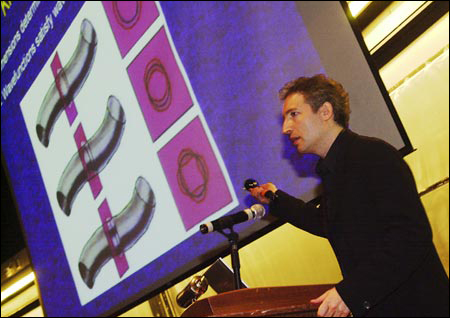
Loeb lecturer Brian Greene has won praise for writings that make complex physics accessible, and he has been compared to astronomer Carl Sagan, who explained the cosmos to the general public in a series of books, lectures, and television programs. (Staff photo Jon Chase/Harvard News Office)

String theory – the idea that the universe is made up not of particles but of tiny vibrating strings – is in the midst of a second revolution that some physicists hope will lead to the long-sought single theory that explains how the universe functions, according to Columbia University Professor Brian Greene.

Greene opened his three-talk series on string theory Monday (April 26) afternoon in a crowded Science Center lecture hall. Greene is this year’s Morris Loeb lecturer, a position established in 1953 by the Physics Department.

Monday’s Loeb colloquium dealt with string theory in a general way, providing background for more technical discussions on Tuesday, when Greene spoke about “String Theory and Geometry” and today (April 29), when he will discuss “String Theory and Cosmology.”

Greene has won praise for his writings that make complex physics accessible, and he has been compared to astronomer Carl Sagan, who explained the cosmos to the general public in a series of books, lectures, and television programs.

Though a professor at Columbia, Greene has Harvard roots. He received his undergraduate degree from Harvard in 1984, and after receiving a doctorate from Oxford, returned to Harvard for postdoctoral research.

Physics Professor Andrew Strominger, who has collaborated with Greene, introduced him. He said Greene’s writings have been praiseworthy partly because Greene has a profound understanding of the subject and is able to translate it well.

Greene’s talk, “Searching for the Unified Theory” provided a general background of string theory, starting with Newton and progressing through Einstein to today’s research.

String theory’s proponents believe it may lead the way at last to the single unified theory that explains the workings of the universe. Quantum field theory explains three of nature’s four forces: the strong and weak forces at work on the atomic level, and the electromagnetic force, which works on the atomic level and at greater distances.

Gravity, which operates across large distances, is explained by the theory of general relativity. The need for two theories to explain how the universe works has sent physicists searching for another way of understanding the universe that would encompass all four forces.

String theory, which visualizes the smallest subatomic particles as tiny vibrating loops of string, may be one of those ways. According to string theory, the strings are the universe’s elemental material. They vibrate in different ways and can join and break apart to form different elemental particles that make up the universe.

Greene gave a brief history of the theory, from its roots in the late 1960s and early 1970s as a failed explanation for the strong force that binds an atomic nucleus, to its resurrection during a “first revolution” in the late 1970s and 1980s as an explanation for all four forces.

He gave an overview of the theory, which though it may explain all four forces presents physicists with other issues, such as the problem that it requires the universe to be made up of 11 dimensions: time, which physicists consider a dimension, and 10 spatial dimensions. Four of those dimensions are the ones we are familiar with, three spatial dimensions plus time. The other dimensions may be curled up and so small they’re invisible to current detection equipment.

Since 1995, Green said string theory has been in what he called a “second revolution” with research advancing rapidly. Still, he said, string theory is “very much a work in progress.”

Previous Post

Ôn tập học kì 1 môn toán lớp 6

Next Post

Nguyên tử khối của Co (coban; cobalt)

Tranducdoan

Tranducdoan

Trần Đức Đoàn sinh năm 1999, anh chàng đẹp trai đến từ Thái Bình. Hiện đang theo học và làm việc tại trường cao đẳng FPT Polytechnic

Next Post

Nguyên tử khối của Co (coban; cobalt)

thời tiết miền bắc đọc sách online cm88 Socolive trực tiếp https://p789bet.biz/ cm88 com socolive https://mb66.black/ xoilactv tructiepbongda Xoilac cakhia tv Trực tiếp bóng đá 90phut f168 f168 MB66 MB66 cm88 com SC88 Socolive TV https://mb66ac.com/
Tài Liệu Học Tập

Copyright © 2022 Tài Liệu Học Tập.

Chuyên Mục

  • Đề Thi
  • Lớp 12
  • Lớp 11
  • Lớp 10
  • Lớp 9
  • Lớp 8
  • Lớp 7
  • Lớp 6
  • Lớp 5
  • Lớp 4
  • Lớp 3
  • Mẹo Hay
  • Tin tức
  • Liên Hệ

Tham Gia Group Tài Liệu Học Tập

No Result
View All Result
  • Đề Thi
  • Lớp 12
    • Lịch Sử Lớp 12
    • Địa Lí Lớp 12
    • Ngữ Văn Lớp 12
    • GD KTPL Lớp 12
    • Toán Lớp 12
    • Tiếng Anh Lớp 12
    • Hóa Học Lớp 12
    • Sinh Học Lớp 12
    • Vật Lí Lớp 12
  • Lớp 11
    • Toán Lớp 11
    • Ngữ Văn Lớp 11
    • Tiếng Anh Lớp 11
    • Hóa Học Lớp 11
    • Sinh Học Lớp 11
    • Vật Lí Lớp 11
    • Lịch Sử Lớp 11
    • Địa Lí Lớp 11
    • GDCD Lớp 11
  • Lớp 10
    • Toán Lớp 10
    • Ngữ Văn Lớp 10
    • Tiếng Anh Lớp 10
    • Hóa Học Lớp 10
    • Sinh Học Lớp 10
    • Vật Lí Lớp 10
    • Lịch Sử Lớp 10
    • Địa Lí Lớp 10
    • GDKTPL Lớp 10
    • Công nghệ lớp 10
    • Tin Học Lớp 10
  • Lớp 9
    • Toán Lớp 9
    • Ngữ Văn Lớp 9
    • Tiếng Anh Lớp 9
    • Lịch sử và địa lý lớp 9
    • Khoa Học Tự Nhiên Lớp 9
    • GDCD Lớp 9
  • Lớp 8
    • Toán Lớp 8
    • Ngữ Văn Lớp 8
    • Tiếng Anh Lớp 8
    • Lịch sử và địa lý lớp 8
    • Khoa Học Tự Nhiên Lớp 8
    • GDCD 8
  • Lớp 7
    • Toán Lớp 7
    • Văn Lớp 7
    • Tiếng Anh Lớp 7
    • Lịch Sử Và Địa Lí Lớp 7
    • Khoa Học Tự Nhiên Lớp 7
  • Lớp 6
    • Toán Lớp 6
    • Văn Lớp 6
    • Tiếng Anh lớp 6
    • Lịch Sử và Địa Lí Lớp 6
    • Khoa Học Tự Nhiên lớp 6
  • Lớp 5
    • Toán lớp 5
    • Tiếng Việt Lớp 5
    • Tiếng Anh Lớp 5
    • Lịch Sử và Địa Lí Lớp 5
  • Lớp 4
    • Toán lớp 4
    • Tiếng Việt Lớp 4
    • Tiếng Anh Lớp 4
    • Lịch Sử và Địa Lí Lớp 4
  • Lớp 3
    • Toán lớp 3
    • Tiếng Anh Lớp 3
    • Tiếng Việt Lớp 3
  • Mẹo Hay
  • Tin tức
  • Liên Hệ

Copyright © 2022 Tài Liệu Học Tập.