
Books seize our imaginations and enter our consciousness. While reading, we visit the world of that book, we feel what it’s like to be someone else, to engage with people, times, places, experiences far beyond our realm of lived experience. Reading enhances not just our knowledge, but our insight, understanding and empathy, qualities that contribute to making us vital human beings.
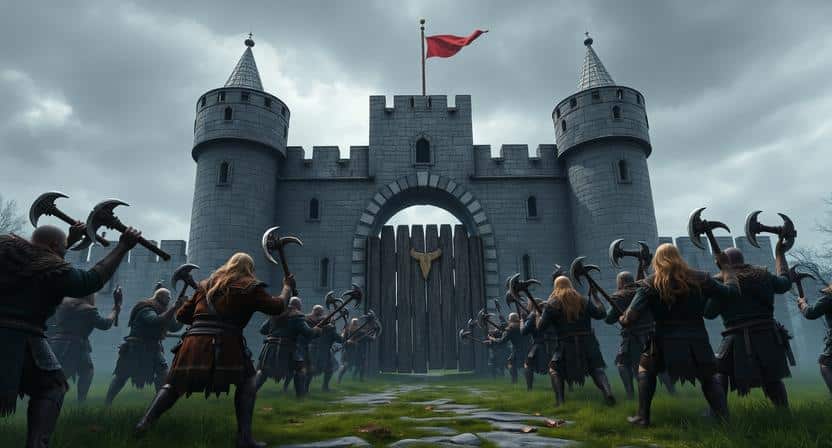
And beyond the personal there’s the universal. Janet Malcolm, doyenne of metaphors, described books as “a kind of last bastion against barbarity.” I used to think of barbarians as primitive inhabitants of the ancient world, huge, axe-wielding fiends striding the land like human dinosaurs, bristling with blood lust. But they’re not confined to the past. They’re everywhere around us, albeit in twenty-first century guise, wearing suits instead of brontosaurus hides, brandishing presidential regalia instead of axes. Faced with the enormity of horrors far beyond our capacity to control or even understand, the temptation is great to retreat into a small silent space, dig a bomb shelter in the backyard and cower there until either the all-clear sounds or the big end of everything arrives. Now, more than ever, we need frigates and bastions and books. We need an antidote against everything that conspires to destroy the idea that individuals matter and that every voice deserves a hearing. We need books to keep the barbarians from the gate.
Books have been as essential to my life as breath ever since I first learned to read. Reading, for me, is an addiction every bit as devouring as a craving for drugs or alcohol. If I were to finish a book and didn’t have another lined up, it would be a catastrophe in the order of not having a bed for the night. To belabour the maritime theme, being without a book would be like being trapped in a sinking ship on a storm-tossed sea without a life-raft or a port anywhere on the horizon.
Alarming as the prospect is, I’ve made sure it’s never going to happen. Every home I’ve inhabited has contained bookcases in every room bar the toilet, and even in some of those, a pile of magazines. A bookcase is my favourite piece of furniture, combining as it does the utilitarian function of storing books and the aesthetic one of adding colour, life and vitality to a room. To me, a bookcase is as essential as … well a toilet. Years ago, when I was young and held parties more often, non-book people would stare dumbfounded at the teetering shelves and say, “Have you read all these?” What did they think? That they were there for show, to flaunt my bookishness? If they’d been leather bound, gold embossed weighty tomes, or heaven forbid designer books, meticulously ordered by colour and size to blend in with the leather Chesterfield and vintage Persian rug, they might have had reason to think the massed collection was a touch pretentious.
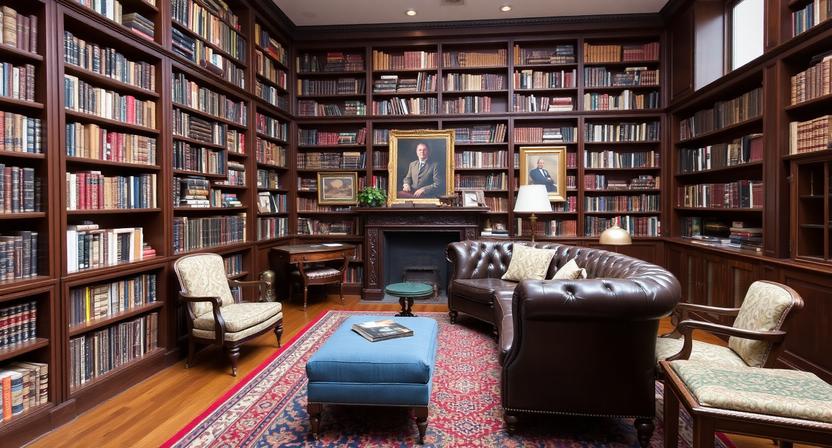
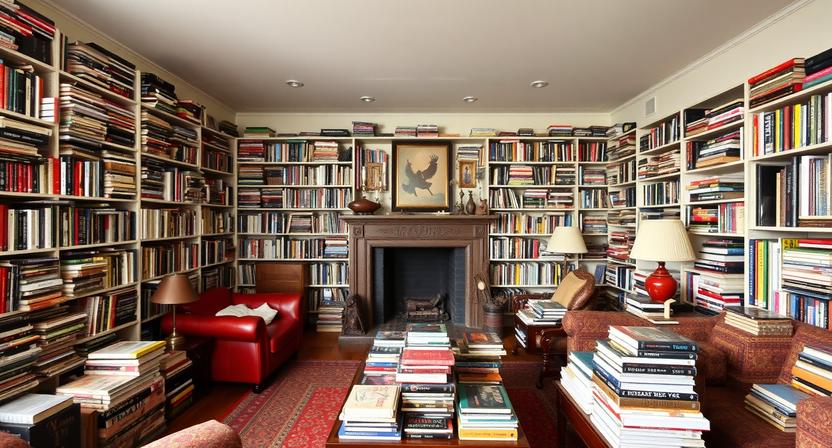
However, it was and still is the most motley and mongrel-like assortment ever seen outside your local Rotary second-hand bookstore. Tattered paperbacks predominate, of all genres and levels of literary distinction. You’ll find Harold Robbins and Patricia Cornwell jostling for space with Thomas Hardy and Virginia Woolf, a large assortment of “how to” volumes – anything from “Get Around Europe on $5 a day” (an old one) to “Get the Perfect Body in One Week” (a museum piece), and here and there amongst the throng books on weighty subjects like politics, literary theory, sociology and other abstruse topics which cost a bomb and haven’t been opened since they were required reading in some long ago university subject. You may well ask, and many have, why not do a cull? Surely there are charities who’d welcome this windfall with open arms?
The reasons against are several. For a start, enthusiastic as charities are to raise money for good causes, surely there’s got to be an easier way than taking on other people’s rubbish, replete as it probably is with soiled thumbprints, variegated stains and questionable marginalia? And keen as impoverished bookworms might be to grab a few bargain reads, any profit the charity makes must be disproportionate to the effort. Culling books is also an arduous and backbreaking task, books and their accumulated dust being collectively far heavier than a bag-full of wardrobe rejects. It’s much easier to leave them there and buy another bookcase or two. Most significantly for me however, tossing out a book feels like dumping a friend. When I’ve devoted a few hours to reading that book, even when it’s been a less than stellar experience, I’ve forged a relationship with it. It’s made me think, perhaps become inspired or provoked even if only to wonder how in the world the author got it published. For better or worse, that relationship has shaped me in some way and consigning the instigator of it (the book) to the land of the great unwanted is an act too harsh to contemplate. So, the books, like a mismatched and wildly divergent extended family remain.
I can trace my bibliophilia back a long way: to my first birthday. On this occasion my grandmother presented me with my first book, “Anne of Green Gables”by Maud Montgomery, a sensible choice in that it was the first in a series featuring the adventures of the intrepid Anne Shirley of Prince Edward Island in Canada. Which meant that at each successive birthday, Grandma could give me the next one. Whatever hopes she might have had about my precocity as a reader, I didn’t manage to master any of them until I could read, at about four. By age five, when I started school, I was, for once, ahead of the pack. A vivid memory is of my Grade 1 teacher giving me a box of MacRobertsons “Old Gold” chocolates for being the first in the class to finish a book. It was probably this that precipitated my bad habit of racing through books as if timed by a stopwatch, spurred on by the subliminal stimuli of those long ago chocolates. (Of course, I’ve long since learned that speed of consumption of both books and chocolates isn’t the best way of enjoying them.)
George Orwell said in his essay “Why I Write” that when he was a child his loneliness led him to “making up stories and holding conversations with imaginary persons”. I came to reading similarly. I was a solitary child who liked my own company and that led to me seeking out imaginary worlds and persons in books, an instinct that’s never changed. My natural state is still solitude, which is where I read and now write. As the world outside my door grows increasingly baleful, I find sanity in books and writing. While assaults on democracy, decency and human values escalate, we need to find a place to refuel our souls, to replenish hope and restore a sense of purpose. For some religion offers this, for others different forms of serving, helping and educating other people does the same. For me, books fulfil that role.
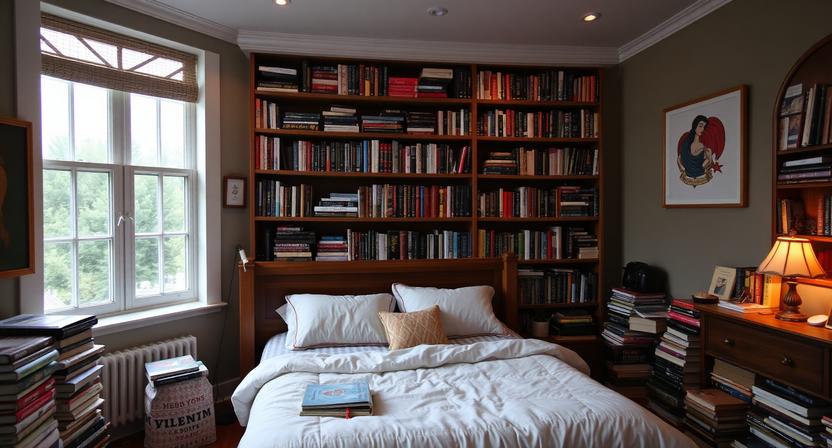
My reading patterns are as eclectic as my bookcases. Unless I start on a hefty biography, I usually read two to three books a week, of whatever genre strikes my fancy. To demonstrate the absurdity of me being book-less, rising stacks of TBR volumes teeter all around me, not to mention unread ebooks hungrily chewing through bytes on my devices. Plus there’s the on-hold list at the library. Rather than a dearth, there’s a glut.
And yet, plowing onward, I’m conscious of the vast shadow that looms behind, of old books I should have read but haven’t. Many so-called experts have kindly provided lists for readers, like me, worried about the paucity of their reading history. Perhaps the most comprehensive of these is the book “1001 Books You Must Read Before You Die” published in 2006 and edited by Peter Boxall.
Given that I might have read one third of these, which is a generous assessment, I have 660-odd to go, which, if I devoted myself solely to the task, I might do in six years or so. What’s interesting about this and other lists is how guilt-inducing they are. For someone like me who smugly considers themselves well-read, to find I haven’t read the bulk of the world’s must-reads is humiliating, to say the least. What have I been doing all this time? Reading rubbish for much of it is the answer that comes to mind. But in whose estimation? Peter Boxall is a Professor of English at Sussex University and according to an article called “Volumes to Go Before You Die” published by William Grimes in The New York Times in 2008, Boxall’s panel of pundits was made up of 105 “mostly obscure” critics, editors and academics. Of course these literary luminaries are not going to shame themselves by admitting to a secret penchant for trashy airport novels. They must put their money where their income is and recommend the books decreed as great by the academy.
Now that I feel like a literary failure, I’m tempted to tackle the 660-odd volumes, starting with number one (“Aesop’s Fables” by Aesopus) and filling in all the glaring gaps right up to the end (“Never Let Me Go” by Kazuo Ishiguro) or in my case the fourth before the end as I have in fact read the last three. There have been many knockoffs propagated since Boxall’s book came out that extend well beyond 2005, and bump up the total to well above 1001. Never has the epithet “so many books so little time” seemed so apt. But the magnitude of the task, I’m sad to say, has defeated me before I even start. With the queue of TBR books shuddering under its own weight and the end considerably closer than it was when I read “Anne of Green Gables”, the only possibility would be to cherry pick a few standouts. Perhaps one or two from each century? Say, “Don Quixote” from the pre-1700s, “Clarissa” from the 1700s, “Frankenstein” from the 1800s, “The Catcher in the Rye” (shock horror – what an omission!) from the 1900s and “The Story of Lucy Gault” from the 2000s. But there are so many begging for attention, it seems unjust to leave the others languishing in the bucket list forever, so, no that’s not a good idea.
Many people however are offended by being told “you must” about anything and will pig-headedly pursue their own agendas, regardless. That is, those of us who are still reading. These days, we’re told, we may be a dying race.
In an article published in the July 21, 2017 issue of The Washington Post called “The death of reading is threatening the soul”, Philip Yancey attributes the reading slump to the scurrilous effects of the Internet and social media. We now have access to so much information, he claims, that it’s making us scatterbrained, literally. Constant exposure to the ceaseless barrage of attention-grabbers on the screen allegedly impairs our brain’s ability to maintain the sustained focus required to read a book, or any long form piece of writing. “My mind strays,” he writes, “and I find myself clicking on the sidebars and the underlined links. Soon I’m over at CNN.com reading Donald Trump’s latest tweets and details of the latest terrorist attack, or perhaps checking tomorrow’s weather.” He’s not alone. Many are the online rabbit holes I’ve stumbled into while leapfrogging from one underlined link to another, in the process completely forgetting what I started out to read and why.
If you look at much online, and who doesn’t these days, you can’t have failed to be sucked in. It’s hard to ignore the flashing, brightly coloured distractions of ads, algorithmically tailored to your viewing history, suggestions along the lines of “if you liked that you’ll like this”, what your favourite stars looked like before Botox, or pop-up boxes asking you to subscribe for more brain deadening fodder, just in case your neurons haven’t keeled over completely and are lying like crushed ants somewhere in the vacuum of your head. And that’s not taking into account the insidious tentacles of AI which are stealthily infiltrating our culture and colonising the formerly sacrosanct territory of human imagination, while we’re checking out the top stories on Sky News.
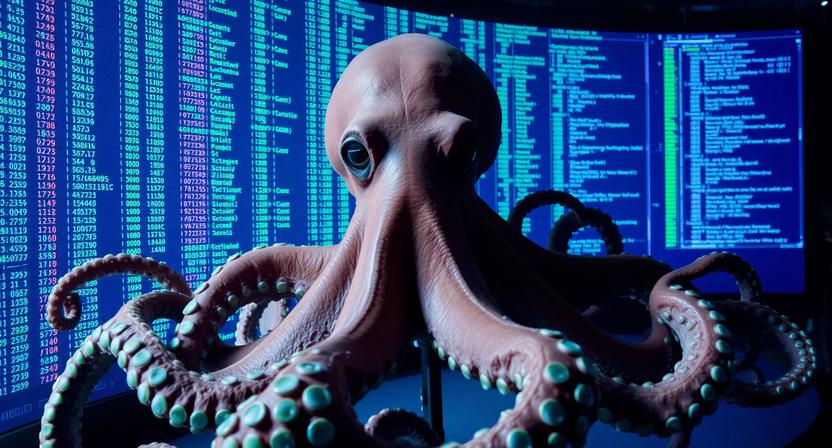
Collectively, aggressive social media and internet technology may lead to a mental pandemic on the scale of Covid. Everyone’s at risk but most egregiously the young, who are, according to many accounts, beginning their journey of learning not through books but on a diet of millisecond bytes that snap at their attention spans and zap them with what neuroscience defines as a dopamine rush, a brief moment of euphoria that’s highly addictive.
In his article Phillip Yancey quotes Nicholas Carr, whose book “The Shallows: What the Internet Is Doing to Our Brains” explores this problem in detail. Carr writes “once I was a scuba diver in the sea of words. Now I zip along the surface like a guy on a Jet Ski”.
Reading requires focus and concentration over a far longer time span than it takes to check your Instagram feed, which might be why many see it as too laborious. In fact, reading a book has been proven to be less tiring than flitting from one thing to another like a pollen crazed bee. It does require some effort, however. The brain must engage actively as opposed to passively which is how we absorb much of the information on social media and through internet browsing. For those who come home exhausted after a workday spent struggling to prevail in an environment more combative than collaborative, this may be just one demand too many.
But the cumulative impact on culture and society of a turning away from books may be direr than we think. In an article published in The Telegraph on 21/8/25 called “The Death of Reading is a Civilisational Catastrophe” Kara Kennedy points out how potentially devastating such a trend might become. She quotes evidence from the University of Florida, University College London and Britain’s National Literacy Trust that shows reading for leisure has declined by 40 per cent in two decades. Children were surveyed about their reading habits and the results show the proportion who enjoy reading has fallen by more than a third. Moreover, the number of children aged between eight and eighteen who read every day has been halved. It’s not only children though, she notes, who are affected. Many schools these days “treat literacy as a boutique concern rather than the foundation of civilisation”, while parents, increasingly burdened by the obligations of working outside the home, encourage their children’s reliance on screens to keep them occupied.
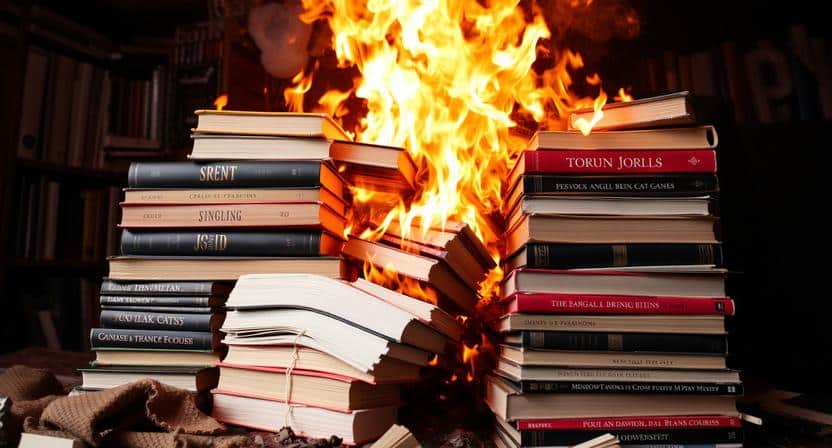
The end result of this accelerating collapse in reading, she points out, will be “functional illiteracy”, a state of “idiocracy” where the great rewards of books and reading will be lost. Instead of the concentrated absorption of information gained through reading, knowledge will be conveyed in rapid fire bytes illuminated by brain-deadening memes, compacted into the tightest possible format to capture the fickle attention spans of consumers whose imaginations have ceased to function through lack of use.
It sounds like a dystopian fantasy, but could it be real? Or is it just another example of catastrophising akin to Y2K, or the killing off of the author, not by Roland Barthes this time, but by AI? It’s tempting to dismiss the idea on those grounds, rather than contemplate it as a real possibility. I often imagine a scenario in which my mother, who died in 1980, suddenly returned to the world of today. The extent of the changes that have taken place in that relatively short time span of forty-six years would defy her comprehension. Given that, what unforeseeable developments might transpire over the next forty-six? What will happen, I wonder, to the books? To the great libraries of the world? To the physical manifestations of man’s search for meaning, the priceless treasures of the world’s learning, the archives, the museums, the antique books, the publishers, the book sellers, the book clubs, the book festivals, the whole vast panoply of our civilisation that rests on the humble book. Where then will those of us addicted to riding the winds of our imagination and sailing the oceans of the unknown turn? It’s unlikely that I’ll be around if that comes to pass, and the colossal scale of the disaster is beyond the scope of my vision.
In 2007, Caleb Crain published an article in The New Yorker called “Twilight of the Books” which attempted to envision such a reality. He doesn’t go so far as to say reading will become extinct, but does note sociologists have predicted that “reading books for pleasure will one day be the province of a special ‘reading class’, much as it was before the arrival of mass literacy, in the second half of the 19th century”. They predict it will come to be regarded as “an increasingly arcane hobby”.

