
First, we had blackboards and chalk. Then whiteboards and dry-wipe pens. Overhead projectors and acetate. Now we have interactive whiteboards. From hefty cathode-ray televisions that were wheeled between classrooms, to flatscreen do-it-all screens, the classroom environment has kept pace with new technologies. So too will the classroom of the future. We’ve come a long way since the 90s. And pretty soon, we’ll be in the 50s.
So, what could the school of the future look like?
Undoubtedly, the biggest development we’ve seen in recent years has been advances in technology, so we can be fairly certain that it will continue to play a significant role in the future. Whereas the traditional model of education has remained largely unchanged for the past 100 or so years – pupils are divided by age and the curriculum broken down into subjects – it has been adapted to incorporate new technologies, as well as responding to economic, social, and political changes. Not to mention pandemic-related upheaval.
It’s unlikely this tried-and-tested model will change drastically over the next 25 or so years, but rather it will adapt to our evolving world.
In 2050, net-zero deadlines will be upon us, and green technology will be comfortably embedded into the classrooms. Recycling will be second nature and there will be no single-use plastics anywhere in schools or universities. Some schools may have gone one step further, with student-grown vertical farms as both a teaching aid and a sustainable resource for the local community.
Technology-driven leaps forward in education will have been gradual and practical. Rather than a complete technological takeover of the classroom rendering schools (almost) unrecognisable, improvement in current technologies and a sustained effort in emerging trends will be the order of the day, with more accessibility and more information available at our fingertips.
And the way we access this information will change. From online learning platforms to more personalised learning experiences alongside the incorporation of virtual and augmented reality, we may see a shift towards a more interactive method of learning. To better prepare students for the workplace, there may be greater emphasis on collaboration and problem-solving, rather than traditional lecture-based, note-taking teaching methods.
Here are a few ways that the school of 2050 may look different.
The classroom environment
On entering the classroom, biometric scanning will allow students to check in, streamlining the hustle-and-bustle of registration. Teachers will be able to collate attendance data automatically, populate perfect attendance records and more easily track patterns of tardiness.
“Sir! I can’t see, the Sun’s blinding me, Sir!”
For the school of the future, there will be no need to wrestle with heavy curtains or dust-covered blinds; we’ll have smart glass. Windows that can automatically adjust their tint to compensate for external brightness, protecting both our eyes and screens.
As summer temperatures continue to rise – the general trend for 2050 being warmer, drier summers as well as warmer, wetter winters – air-conditioned classrooms will become the norm. But they will be cleaner, more efficient, and sustainable, with built-in air purifiers to remove toxins and dust from the air.
By 2050, 3D printers will have become a standard appliance, both in the home and at school. As a learning aid, they will have become essential, allowing teachers more flexibility to explain difficult concepts.
Students will be able to physically manipulate objects for better information processing, visual perception, and cognitive learning. The structure of an eye? Easy. Exploring archaeological artefacts without risk of damage? No problem. Understanding the now-antique internal combustion engine? That too.
Augmented reality and AI
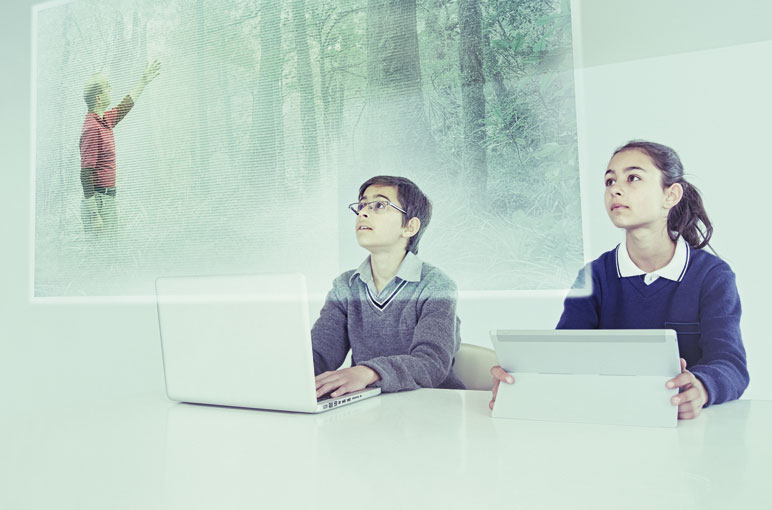
Adaptive learning systems driven by artificial Intelligence (AI) will have become integrated into the school environment by 2050. Personalised learning experiences will take into account learning styles and create adaptive assessments that adjust in real-time based on performance.
AI may also be used to analyse pupils’ work, even so far as predicting future performance, helping teachers understand which students need more guidance on a particular concept before they fall behind.
Students will be able to get immediate feedback, with suggested areas for improvement and more personalised tutoring, tailoring to a student’s strengths and weaknesses. This isn’t a new concept, Intelligent Tutoring Systems (ITS) have been proposed for decades, but AI will make it considerably easier.
The move towards more immersive and interactive learning experiences will also be facilitated by the application of augmented reality and advances in AI. Interactive whiteboards will be kitted out with augmented reality – where virtual objects are superimposed onto the real world – which will be particularly useful for STEM subjects, allowing students to digitally dissect the human brain, analyse chemical compounds in the clouds of Jupiter, or make size comparisons of dinosaurs.
But with AI having become more widely accessible – like the recently launched ChatGPT which can generate sophisticated paragraphs of writing from prompts – so too will new plagiarism detection software. Sorry, students.
The internet, accessibility and remote learning
The pandemic has brought remote learning into the limelight. With a global population predicted to reach 9.8 billion by 2050, and around 90 per cent expected to have internet by then, it’s possible that classrooms will be shared virtually with external pupils, providing learning to home students and allowing for larger class sizes.
And with more pupils, teachers will have come to rely on AI automation of certain aspects (administrative tasks like registrations and tracking grades), to ensure the best possible service, allowing them to focus on teaching.
So it’s very unlikely that the internet itself will disappear by 2050. But it will change. We’re already seeing hard drive storage replaced by virtual clouds; in-progress documents accessible from multiple devices and from any location, and it’s likely this trend towards greater connectivity will continue. 5G will be a thing of the past, but high-speed networks are here to stay, and we can expect to see more data-intensive applications and services as time goes on.
The use of Internet of Things technology will be widespread, with more devices and appliances connected to the internet, enabling greater automation and control over the school environment. Outside the classroom, for example, you might encounter robot cleaners tidying the halls while lessons are in session.
With a few exceptions, homework assignments will mostly be online. From downloading the assignment at the end of the lesson, to submitting it remotely (as many do now), students will be able to view their coursework, see the percentage completed, and track overall assessments.
Instant notifications will alert pupils to deadline extensions, feedback, and grades. Parents and teachers will be able to track progress, addressing issues as and when they arise.
Learning in the metaverse
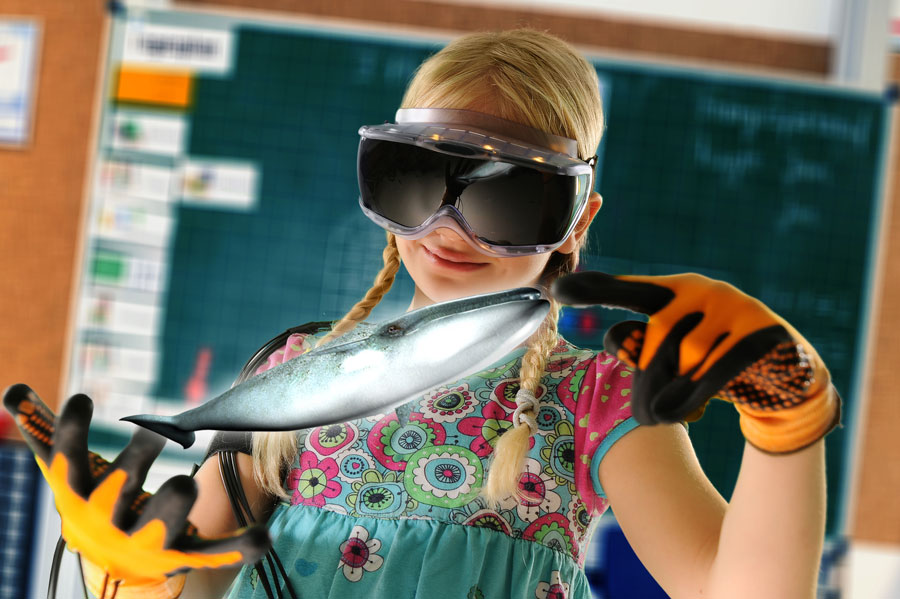
And of course, with the internet comes social media. And by 2050, the Metaverse – a shared immersive virtual space, where we can be free of our bodies, inhabiting our own digital avatars - will be well established.
Wouldn’t it be great to try clothes in the metaverse and have the physical product shipped to us in the real world? If the Metaverse comes to fruition, it will undoubtedly be a game-changer for online shopping, but what about education?
Virtual and augmented reality technology will likely be advanced enough to create a sufficiently immersive and interactive learning environment, perhaps even linked in with the real world; a teacher’s physical words and movements translating seamlessly to their avatar.
But as more personal information is shared online, and we spend more time in the Metaverse, there will be a greater emphasis on protecting a user’s security and privacy. We may even see cyber security modules being incorporated into some subjects.
Of course, schools aren’t solely for educational development; they’re for social and emotional development, too. In that respect, it’s unlikely the metaverse will completely replace the real-world setting. Instead, it will supplement it to allow access to global educational resources and facilitate interactions with exchange students from other schools.
Literature
Just like Captain Jean Luc Picard likes to settle down with an old leather-bound copy of Herman Melville’s Moby Dick in the 24th Century, physical libraries will still exist in the mid-21st Century.
AR books will be common, but just as Kindle and e-books have exploded in popularity over the last decade or so, access to reading material will become easier. Gone will be the days of lugging heavy textbooks around, hastily cramming them into lockers after lessons.
Students of the future can look forward to having recommended reading materials right at their fingertips, via e-readers and tablet devices which can be digitally annotated, or manipulated via VR.
We can already do this with today’s e-ink devices, and since tablets have been introduced as an integral learning device in the last decade, studies have shown that they can motivate both pupils and teachers, emphasising interactivity and keeping them engaged with the content for longer.
By extension, digital literacy will be improved, and kids of the future will be even more tech-savvy than your toddler who already knows how to buy Fortnite skins.
Subsequently, reliance on paper products will be reduced, although not eliminated completely. Artists have been using paper for thousands of years, so it’s unlikely we’ll ever see its complete disappearance, especially in art and design subjects. The paper we do use, however, will be eco-friendly; either recycled, or made from fast-growing plants like bamboo.
Read more:
- 22 ideas about to change our world
- Is augmented reality the future of doctor’s appointments?
- UK heatwave: Are these searing temperatures the future of summers in the UK?

