Tài Liệu Học Tập
No Result
View All Result
  • Đề Thi
  • Lớp 12
    • Lịch Sử Lớp 12
    • Địa Lí Lớp 12
    • Ngữ Văn Lớp 12
    • GD KTPL Lớp 12
    • Toán Lớp 12
    • Tiếng Anh Lớp 12
    • Hóa Học Lớp 12
    • Sinh Học Lớp 12
    • Vật Lí Lớp 12
  • Lớp 11
    • Toán Lớp 11
    • Ngữ Văn Lớp 11
    • Tiếng Anh Lớp 11
    • Hóa Học Lớp 11
    • Sinh Học Lớp 11
    • Vật Lí Lớp 11
    • Lịch Sử Lớp 11
    • Địa Lí Lớp 11
    • GDCD Lớp 11
  • Lớp 10
    • Toán Lớp 10
    • Ngữ Văn Lớp 10
    • Tiếng Anh Lớp 10
    • Hóa Học Lớp 10
    • Sinh Học Lớp 10
    • Vật Lí Lớp 10
    • Lịch Sử Lớp 10
    • Địa Lí Lớp 10
    • GDKTPL Lớp 10
    • Công nghệ lớp 10
    • Tin Học Lớp 10
  • Lớp 9
    • Toán Lớp 9
    • Ngữ Văn Lớp 9
    • Tiếng Anh Lớp 9
    • Lịch sử và địa lý lớp 9
    • Khoa Học Tự Nhiên Lớp 9
    • GDCD Lớp 9
  • Lớp 8
    • Toán Lớp 8
    • Ngữ Văn Lớp 8
    • Tiếng Anh Lớp 8
    • Lịch sử và địa lý lớp 8
    • Khoa Học Tự Nhiên Lớp 8
    • GDCD 8
  • Lớp 7
    • Toán Lớp 7
    • Văn Lớp 7
    • Tiếng Anh Lớp 7
    • Lịch Sử Và Địa Lí Lớp 7
    • Khoa Học Tự Nhiên Lớp 7
  • Lớp 6
    • Toán Lớp 6
    • Văn Lớp 6
    • Tiếng Anh lớp 6
    • Lịch Sử và Địa Lí Lớp 6
    • Khoa Học Tự Nhiên lớp 6
  • Lớp 5
    • Toán lớp 5
    • Tiếng Việt Lớp 5
    • Tiếng Anh Lớp 5
    • Lịch Sử và Địa Lí Lớp 5
  • Lớp 4
    • Toán lớp 4
    • Tiếng Việt Lớp 4
    • Tiếng Anh Lớp 4
    • Lịch Sử và Địa Lí Lớp 4
  • Lớp 3
    • Toán lớp 3
    • Tiếng Anh Lớp 3
    • Tiếng Việt Lớp 3
  • Mẹo Hay
  • Tin tức
  • Liên Hệ
Tài Liệu Học Tập
No Result
View All Result
Home Toán tổng hợp

Minkowski inequality

by Tranducdoan
26/03/2026
in Toán tổng hợp
0
Đánh giá bài viết

In mathematical analysis, the Minkowski inequality establishes that the L p {displaystyle L^{p}} {displaystyle L^{p}} spaces satisfy the triangle inequality in the definition of normed vector spaces. The inequality is named after the German mathematician Hermann Minkowski.

Let S {textstyle S} {textstyle S} be a measure space, let 1 ≤ p ≤ ∞ {textstyle 1leq pleq infty } {textstyle 1leq pleq infty } and let f {textstyle f} {textstyle f} and g {textstyle g} {textstyle g} be elements of L p ( S ) . {textstyle L^{p}(S).} {textstyle L^{p}(S).} Then f + g {textstyle f+g} {textstyle f+g} is in L p ( S ) , {textstyle L^{p}(S),} {textstyle L^{p}(S),} and we have the triangle inequality

‖ f + g ‖ p ≤ ‖ f ‖ p + ‖ g ‖ p {displaystyle |f+g|_{p}leq |f|_{p}+|g|_{p}} {displaystyle |f+g|_{p}leq |f|_{p}+|g|_{p}}

with equality for 1 < p < ∞ {textstyle 1<p<infty } {textstyle 1<p<infty } if and only if f {textstyle f} {textstyle f} and g {textstyle g} {textstyle g} are positively linearly dependent; that is, f = λ g {textstyle f=lambda g} {textstyle f=lambda g} for some λ ≥ 0 {textstyle lambda geq 0} {textstyle lambda geq 0} or g = 0. {textstyle g=0.} {textstyle g=0.} Here, the norm is given by:

‖ f ‖ p = ( ∫ | f | p d μ ) 1 p {displaystyle |f|_{p}=left(int |f|^{p}dmu right)^{frac {1}{p}}} {displaystyle |f|_{p}=left(int |f|^{p}dmu right)^{frac {1}{p}}}
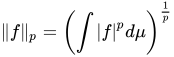
if p < ∞ , {textstyle p<infty ,} {textstyle p<infty ,} or in the case p = ∞ {textstyle p=infty } {textstyle p=infty } by the essential supremum

‖ f ‖ ∞ = e s s s u p x ∈ S ⁡ | f ( x ) | . {displaystyle |f|_{infty }=operatorname {ess sup} _{xin S}|f(x)|.} {displaystyle |f|_{infty }=operatorname {ess sup} _{xin S}|f(x)|.}

The Minkowski inequality is the triangle inequality in L p ( S ) . {textstyle L^{p}(S).} {textstyle L^{p}(S).} In fact, it is a special case of the more general fact

‖ f ‖ p = sup ‖ g ‖ q = 1 ∫ | f g | d μ , 1 p + 1 q = 1 {displaystyle |f|_{p}=sup _{|g|_{q}=1}int |fg|dmu ,qquad {tfrac {1}{p}}+{tfrac {1}{q}}=1} {displaystyle |f|_{p}=sup _{|g|_{q}=1}int |fg|dmu ,qquad {tfrac {1}{p}}+{tfrac {1}{q}}=1}

where it is easy to see that the right-hand side satisfies the triangular inequality.

Like Hölder’s inequality, the Minkowski inequality can be specialized to sequences and vectors by using the counting measure:

( ∑ k = 1 n | x k + y k | p ) 1 / p ≤ ( ∑ k = 1 n | x k | p ) 1 / p + ( ∑ k = 1 n | y k | p ) 1 / p {displaystyle left(sum _{k=1}^{n}|x_{k}+y_{k}|^{p}right)^{1/p}leq left(sum _{k=1}^{n}|x_{k}|^{p}right)^{1/p}+left(sum _{k=1}^{n}|y_{k}|^{p}right)^{1/p}} {displaystyle left(sum _{k=1}^{n}|x_{k}+y_{k}|^{p}right)^{1/p}leq left(sum _{k=1}^{n}|x_{k}|^{p}right)^{1/p}+left(sum _{k=1}^{n}|y_{k}|^{p}right)^{1/p}}

for all real (or complex) numbers x 1 , … , x n , y 1 , … , y n {textstyle x_{1},dots ,x_{n},y_{1},dots ,y_{n}} {textstyle x_{1},dots ,x_{n},y_{1},dots ,y_{n}} and where n {textstyle n} {textstyle n} is the cardinality of S {textstyle S} {textstyle S} (the number of elements in S {textstyle S} {textstyle S}).

In probabilistic terms, given the probability space ( Ω , F , P ) , {displaystyle (Omega ,{mathcal {F}},mathbb {P} ),} {displaystyle (Omega ,{mathcal {F}},mathbb {P} ),} and E {displaystyle mathbb {E} } {displaystyle mathbb {E} } denote the expectation operator for every real- or complex-valued random variables X {displaystyle X} {displaystyle X} and Y {displaystyle Y} {displaystyle Y} on Ω , {displaystyle Omega ,} {displaystyle Omega ,} Minkowski’s inequality reads

( E [ | X + Y | p ] ) 1 p ⩽ ( E [ | X | p ] ) 1 p + ( E [ | Y | p ] ) 1 p . {displaystyle left(mathbb {E} [|X+Y|^{p}]right)^{frac {1}{p}}leqslant left(mathbb {E} [|X|^{p}]right)^{frac {1}{p}}+left(mathbb {E} [|Y|^{p}]right)^{frac {1}{p}}.} {displaystyle left(mathbb {E} [|X+Y|^{p}]right)^{frac {1}{p}}leqslant left(mathbb {E} [|X|^{p}]right)^{frac {1}{p}}+left(mathbb {E} [|Y|^{p}]right)^{frac {1}{p}}.}

First, we prove that f + g {textstyle f+g} {textstyle f+g} has finite p {textstyle p} {textstyle p}-norm if f {textstyle f} {textstyle f} and g {textstyle g} {textstyle g} both do, which follows by

| f + g | p ≤ 2 p − 1 ( | f | p + | g | p ) . {displaystyle |f+g|^{p}leq 2^{p-1}(|f|^{p}+|g|^{p}).} {displaystyle |f+g|^{p}leq 2^{p-1}(|f|^{p}+|g|^{p}).}

Indeed, here we use the fact that h ( x ) = | x | p {textstyle h(x)=|x|^{p}} {textstyle h(x)=|x|^{p}} is convex over R + {textstyle mathbb {R} ^{+}} {textstyle mathbb {R} ^{+}} (for p > 1 {textstyle p>1} {textstyle p>1}) and so, by the definition of convexity,

| 1 2 f + 1 2 g | p ≤ | 1 2 | f | + 1 2 | g | | p ≤ 1 2 | f | p + 1 2 | g | p . {displaystyle left|{tfrac {1}{2}}f+{tfrac {1}{2}}gright|^{p}leq left|{tfrac {1}{2}}|f|+{tfrac {1}{2}}|g|right|^{p}leq {tfrac {1}{2}}|f|^{p}+{tfrac {1}{2}}|g|^{p}.} {displaystyle left|{tfrac {1}{2}}f+{tfrac {1}{2}}gright|^{p}leq left|{tfrac {1}{2}}|f|+{tfrac {1}{2}}|g|right|^{p}leq {tfrac {1}{2}}|f|^{p}+{tfrac {1}{2}}|g|^{p}.}

This means that

| f + g | p ≤ 1 2 | 2 f | p + 1 2 | 2 g | p = 2 p − 1 | f | p + 2 p − 1 | g | p . {displaystyle |f+g|^{p}leq {tfrac {1}{2}}|2f|^{p}+{tfrac {1}{2}}|2g|^{p}=2^{p-1}|f|^{p}+2^{p-1}|g|^{p}.} {displaystyle |f+g|^{p}leq {tfrac {1}{2}}|2f|^{p}+{tfrac {1}{2}}|2g|^{p}=2^{p-1}|f|^{p}+2^{p-1}|g|^{p}.}

Now, we can legitimately talk about ‖ f + g ‖ p {textstyle |f+g|_{p}} {textstyle |f+g|_{p}}. If it is zero, then Minkowski’s inequality holds. We now assume that ‖ f + g ‖ p {textstyle |f+g|_{p}} {textstyle |f+g|_{p}} is not zero. Using the triangle inequality and then Hölder’s inequality, we find that

‖ f + g ‖ p p = ∫ | f + g | p d μ = ∫ | f + g | ⋅ | f + g | p − 1 d μ ≤ ∫ ( | f | + | g | ) | f + g | p − 1 d μ = ∫ | f | | f + g | p − 1 d μ + ∫ | g | | f + g | p − 1 d μ ≤ ( ( ∫ | f | p d μ ) 1 p + ( ∫ | g | p d μ ) 1 p ) ( ∫ | f + g | ( p − 1 ) ( p p − 1 ) d μ ) 1 − 1 p Hölder’s inequality = ( ‖ f ‖ p + ‖ g ‖ p ) ‖ f + g ‖ p p ‖ f + g ‖ p {displaystyle {begin{aligned}|f+g|_{p}^{p}&=int |f+g|^{p},mathrm {d} mu &=int |f+g|cdot |f+g|^{p-1},mathrm {d} mu &leq int (|f|+|g|)|f+g|^{p-1},mathrm {d} mu &=int |f||f+g|^{p-1},mathrm {d} mu +int |g||f+g|^{p-1},mathrm {d} mu &leq left(left(int |f|^{p},mathrm {d} mu right)^{frac {1}{p}}+left(int |g|^{p},mathrm {d} mu right)^{frac {1}{p}}right)left(int |f+g|^{(p-1)left({frac {p}{p-1}}right)},mathrm {d} mu right)^{1-{frac {1}{p}}}&&{text{ Hölder’s inequality}}&=left(|f|_{p}+|g|_{p}right){frac {|f+g|_{p}^{p}}{|f+g|_{p}}}end{aligned}}} {displaystyle {begin{aligned}|f+g|_{p}^{p}&=int |f+g|^{p},mathrm {d} mu &=int |f+g|cdot |f+g|^{p-1},mathrm {d} mu &leq int (|f|+|g|)|f+g|^{p-1},mathrm {d} mu &=int |f||f+g|^{p-1},mathrm {d} mu +int |g||f+g|^{p-1},mathrm {d} mu &leq left(left(int |f|^{p},mathrm {d} mu right)^{frac {1}{p}}+left(int |g|^{p},mathrm {d} mu right)^{frac {1}{p}}right)left(int |f+g|^{(p-1)left({frac {p}{p-1}}right)},mathrm {d} mu right)^{1-{frac {1}{p}}}&&{text{ Hölder's inequality}}&=left(|f|_{p}+|g|_{p}right){frac {|f+g|_{p}^{p}}{|f+g|_{p}}}end{aligned}}}
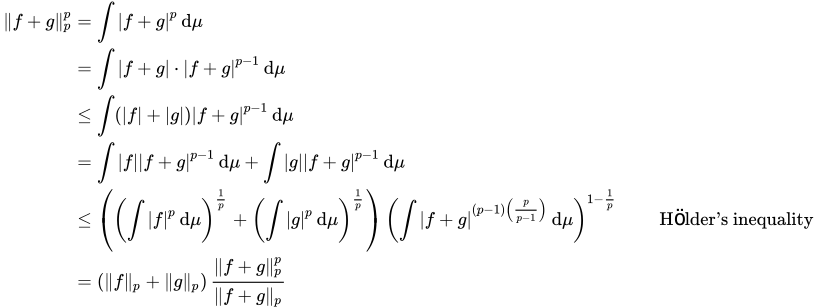
We obtain Minkowski’s inequality by multiplying both sides by

‖ f + g ‖ p ‖ f + g ‖ p p . {displaystyle {frac {|f+g|_{p}}{|f+g|_{p}^{p}}}.} {displaystyle {frac {|f+g|_{p}}{|f+g|_{p}^{p}}}.}

Given t ∈ ( 0 , 1 ) {displaystyle tin (0,1)} {displaystyle tin (0,1)}, one has, by convexity (Jensen’s inequality), for every x ∈ S {displaystyle xin S} {displaystyle xin S}

| f ( x ) + g ( x ) | p = | ( 1 − t ) f ( x ) 1 − t + t g ( x ) t | p ≤ ( 1 − t ) | f ( x ) 1 − t | p + t | g ( x ) t | p = | f ( x ) | p ( 1 − t ) p − 1 + | g ( x ) | p t p − 1 . {displaystyle |f(x)+g(x)|^{p}={Bigl |}(1-t){frac {f(x)}{1-t}}+t{frac {g(x)}{t}}{Bigr |}^{p}leq (1-t){Bigl |}{frac {f(x)}{1-t}}{Bigr |}^{p}+t{Bigl |}{frac {g(x)}{t}}{Bigr |}^{p}={frac {|f(x)|^{p}}{(1-t)^{p-1}}}+{frac {|g(x)|^{p}}{t^{p-1}}}.} {displaystyle |f(x)+g(x)|^{p}={Bigl |}(1-t){frac {f(x)}{1-t}}+t{frac {g(x)}{t}}{Bigr |}^{p}leq (1-t){Bigl |}{frac {f(x)}{1-t}}{Bigr |}^{p}+t{Bigl |}{frac {g(x)}{t}}{Bigr |}^{p}={frac {|f(x)|^{p}}{(1-t)^{p-1}}}+{frac {|g(x)|^{p}}{t^{p-1}}}.}

By integration this leads to

∫ S | f + g | p d μ ≤ 1 ( 1 − t ) p − 1 ∫ S | f | p d μ + 1 t p − 1 ∫ S | g | p d μ . {displaystyle int _{S}|f+g|^{p},mathrm {d} mu leq {frac {1}{(1-t)^{p-1}}}int _{S}|f|^{p},mathrm {d} mu +{frac {1}{t^{p-1}}}int _{S}|g|^{p},mathrm {d} mu .} {displaystyle int _{S}|f+g|^{p},mathrm {d} mu leq {frac {1}{(1-t)^{p-1}}}int _{S}|f|^{p},mathrm {d} mu +{frac {1}{t^{p-1}}}int _{S}|g|^{p},mathrm {d} mu .}

One takes then

t = ‖ g ‖ p ‖ f ‖ p + ‖ g ‖ p {displaystyle t={frac {Vert gVert _{p}}{Vert fVert _{p}+Vert gVert _{p}}}} {displaystyle t={frac {Vert gVert _{p}}{Vert fVert _{p}+Vert gVert _{p}}}}

to reach the conclusion.

Suppose that ( S 1 , μ 1 ) {textstyle (S_{1},mu _{1})} {textstyle (S_{1},mu _{1})} and ( S 2 , μ 2 ) {textstyle (S_{2},mu _{2})} {textstyle (S_{2},mu _{2})} are two 𝜎-finite measure spaces and F : S 1 × S 2 → R {textstyle F:S_{1}times S_{2}to mathbb {R} } {textstyle F:S_{1}times S_{2}to mathbb {R} } is measurable. Then Minkowski’s integral inequality is:[1][2]

[ ∫ S 2 | ∫ S 1 F ( x , y ) μ 1 ( d x ) | p μ 2 ( d y ) ] 1 p ≤ ∫ S 1 ( ∫ S 2 | F ( x , y ) | p μ 2 ( d y ) ) 1 p μ 1 ( d x ) , p ∈ [ 1 , ∞ ) {displaystyle left[int _{S_{2}}left|int _{S_{1}}F(x,y),mu _{1}(mathrm {d} x)right|^{p}mu _{2}(mathrm {d} y)right]^{frac {1}{p}}~leq ~int _{S_{1}}left(int _{S_{2}}|F(x,y)|^{p},mu _{2}(mathrm {d} y)right)^{frac {1}{p}}mu _{1}(mathrm {d} x),quad pin [1,infty )} {displaystyle left[int _{S_{2}}left|int _{S_{1}}F(x,y),mu _{1}(mathrm {d} x)right|^{p}mu _{2}(mathrm {d} y)right]^{frac {1}{p}}~leq ~int _{S_{1}}left(int _{S_{2}}|F(x,y)|^{p},mu _{2}(mathrm {d} y)right)^{frac {1}{p}}mu _{1}(mathrm {d} x),quad pin [1,infty )}

with obvious modifications in the case p = ∞ . {textstyle p=infty .} {textstyle p=infty .} If p > 1 , {textstyle p>1,} {textstyle p>1,} and both sides are finite, then equality holds only if | F ( x , y ) | = φ ( x ) ψ ( y ) {textstyle |F(x,y)|=varphi (x),psi (y)} {textstyle |F(x,y)|=varphi (x),psi (y)} a.e. for some non-negative measurable functions φ {textstyle varphi } {textstyle varphi } and ψ {textstyle psi } {textstyle psi }.

If μ 1 {textstyle mu _{1}} {textstyle mu _{1}} is the counting measure on a two-point set S 1 = { 1 , 2 } , {textstyle S_{1}={1,2},} {textstyle S_{1}={1,2},} then Minkowski’s integral inequality gives the usual Minkowski inequality as a special case: for putting f i ( y ) = F ( i , y ) {textstyle f_{i}(y)=F(i,y)} {textstyle f_{i}(y)=F(i,y)} for i = 1 , 2 , {textstyle i=1,2,} {textstyle i=1,2,} the integral inequality gives

‖ f 1 + f 2 ‖ p = ( ∫ S 2 | ∫ S 1 F ( x , y ) μ 1 ( d x ) | p μ 2 ( d y ) ) 1 p ≤ ∫ S 1 ( ∫ S 2 | F ( x , y ) | p μ 2 ( d y ) ) 1 p μ 1 ( d x ) = ‖ f 1 ‖ p + ‖ f 2 ‖ p . {displaystyle |f_{1}+f_{2}|_{p}=left(int _{S_{2}}left|int _{S_{1}}F(x,y),mu _{1}(mathrm {d} x)right|^{p}mu _{2}(mathrm {d} y)right)^{frac {1}{p}}leq int _{S_{1}}left(int _{S_{2}}|F(x,y)|^{p},mu _{2}(mathrm {d} y)right)^{frac {1}{p}}mu _{1}(mathrm {d} x)=|f_{1}|_{p}+|f_{2}|_{p}.} {displaystyle |f_{1}+f_{2}|_{p}=left(int _{S_{2}}left|int _{S_{1}}F(x,y),mu _{1}(mathrm {d} x)right|^{p}mu _{2}(mathrm {d} y)right)^{frac {1}{p}}leq int _{S_{1}}left(int _{S_{2}}|F(x,y)|^{p},mu _{2}(mathrm {d} y)right)^{frac {1}{p}}mu _{1}(mathrm {d} x)=|f_{1}|_{p}+|f_{2}|_{p}.}

If the measurable function F : S 1 × S 2 → R {textstyle F:S_{1}times S_{2}to mathbb {R} } {textstyle F:S_{1}times S_{2}to mathbb {R} } is non-negative then for all 1 ≤ p ≤ q ≤ ∞ , {textstyle 1leq pleq qleq infty ,} {textstyle 1leq pleq qleq infty ,}[3]

‖ ‖ F ( ⋅ , s 2 ) ‖ L p ( S 1 , μ 1 ) ‖ L q ( S 2 , μ 2 ) ≤ ‖ ‖ F ( s 1 , ⋅ ) ‖ L q ( S 2 , μ 2 ) ‖ L p ( S 1 , μ 1 ) . {displaystyle left|left|F(,cdot ,s_{2})right|_{L^{p}(S_{1},mu _{1})}right|_{L^{q}(S_{2},mu _{2})}~leq ~left|left|F(s_{1},cdot )right|_{L^{q}(S_{2},mu _{2})}right|_{L^{p}(S_{1},mu _{1})} .} {displaystyle left|left|F(,cdot ,s_{2})right|_{L^{p}(S_{1},mu _{1})}right|_{L^{q}(S_{2},mu _{2})}~leq ~left|left|F(s_{1},cdot )right|_{L^{q}(S_{2},mu _{2})}right|_{L^{p}(S_{1},mu _{1})} .}

This notation has been generalized to

‖ f ‖ p , q = ( ∫ R m [ ∫ R n | f ( x , y ) | q d y ] p q d x ) 1 p {displaystyle |f|_{p,q}=left(int _{mathbb {R} ^{m}}left[int _{mathbb {R} ^{n}}|f(x,y)|^{q}mathrm {d} yright]^{frac {p}{q}}mathrm {d} xright)^{frac {1}{p}}} {displaystyle |f|_{p,q}=left(int _{mathbb {R} ^{m}}left[int _{mathbb {R} ^{n}}|f(x,y)|^{q}mathrm {d} yright]^{frac {p}{q}}mathrm {d} xright)^{frac {1}{p}}}

for f : R m + n → E , {textstyle f:mathbb {R} ^{m+n}to E,} {textstyle f:mathbb {R} ^{m+n}to E,} with L p , q ( R m + n , E ) = { f ∈ E R m + n : ‖ f ‖ p , q < ∞ } . {textstyle {mathcal {L}}_{p,q}(mathbb {R} ^{m+n},E)={fin E^{mathbb {R} ^{m+n}}:|f|_{p,q}<infty }.} {textstyle {mathcal {L}}_{p,q}(mathbb {R} ^{m+n},E)={fin E^{mathbb {R} ^{m+n}}:|f|_{p,q}<infty }.} Using this notation, manipulation of the exponents reveals that, if p < q , {textstyle p<q,} {textstyle p<q,} then ‖ f ‖ q , p ≤ ‖ f ‖ p , q {textstyle |f|_{q,p}leq |f|_{p,q}} {textstyle |f|_{q,p}leq |f|_{p,q}}.

When p < 1 {textstyle p<1} {textstyle p<1} the reverse inequality holds:

‖ f + g ‖ p ≥ ‖ f ‖ p + ‖ g ‖ p . {displaystyle |f+g|_{p}geq |f|_{p}+|g|_{p}.} {displaystyle |f+g|_{p}geq |f|_{p}+|g|_{p}.}

We further need the restriction that both f {textstyle f} {textstyle f} and g {textstyle g} {textstyle g} are non-negative, as we can see from the example f = − 1 , g = 1 {textstyle f=-1,g=1} {textstyle f=-1,g=1} and p = 1 {textstyle p=1} {textstyle p=1}

‖ f + g ‖ 1 = 0 < 2 = ‖ f ‖ 1 + ‖ g ‖ 1 . {textstyle |f+g|_{1}=0<2=|f|_{1}+|g|_{1}.} {textstyle |f+g|_{1}=0<2=|f|_{1}+|g|_{1}.}

The reverse inequality follows from the same argument as the standard Minkowski, but uses that Holder’s inequality is also reversed in this range.

Using the Reverse Minkowski, we may prove that power means with p ≤ 1 , {textstyle pleq 1,} {textstyle pleq 1,} such as the harmonic mean and the geometric mean are concave.

The Minkowski inequality can be generalized to other functions ϕ ( x ) {textstyle phi (x)} {textstyle phi (x)} beyond the power function x p {textstyle x^{p}} {textstyle x^{p}}. The generalized inequality has the form

ϕ − 1 ( ∑ i = 1 n ϕ ( x i + y i ) ) ≤ ϕ − 1 ( ∑ i = 1 n ϕ ( x i ) ) + ϕ − 1 ( ∑ i = 1 n ϕ ( y i ) ) . {displaystyle phi ^{-1}left(textstyle sum limits _{i=1}^{n}phi (x_{i}+y_{i})right)leq phi ^{-1}left(textstyle sum limits _{i=1}^{n}phi (x_{i})right)+phi ^{-1}left(textstyle sum limits _{i=1}^{n}phi (y_{i})right).} {displaystyle phi ^{-1}left(textstyle sum limits _{i=1}^{n}phi (x_{i}+y_{i})right)leq phi ^{-1}left(textstyle sum limits _{i=1}^{n}phi (x_{i})right)+phi ^{-1}left(textstyle sum limits _{i=1}^{n}phi (y_{i})right).}

Various sufficient conditions on ϕ {textstyle phi } {textstyle phi } have been found by Mulholland[4] and others. For example, for x ≥ 0 {textstyle xgeq 0} {textstyle xgeq 0} one set of sufficient conditions from Mulholland is

  1. ϕ ( x ) {textstyle phi (x)} {textstyle phi (x)} is continuous and strictly increasing with ϕ ( 0 ) = 0. {textstyle phi (0)=0.} {textstyle phi (0)=0.}
  2. ϕ ( x ) {textstyle phi (x)} {textstyle phi (x)} is a convex function of x . {textstyle x.} {textstyle x.}
  3. log ⁡ ϕ ( x ) {textstyle log phi (x)} {textstyle log phi (x)} is a convex function of log ⁡ ( x ) . {textstyle log(x).} {textstyle log(x).}
  • Cauchy-Schwarz inequality – Mathematical inequality relating inner products and norms
  • Hölder’s inequality – Inequality between integrals in Lp spaces
  • Mahler’s inequality
  • Young’s convolution inequality – Mathematical inequality about the convolution of two functions
  • Young’s inequality for products – Mathematical concept
  • Bahouri, Hajer; Chemin, Jean-Yves; Danchin, Raphaël (2011). Fourier Analysis and Nonlinear Partial Differential Equations. Grundlehren der mathematischen Wissenschaften. Vol. 343. Berlin, Heidelberg: Springer. ISBN 978-3-642-16830-7. OCLC 704397128.
  • Hardy, G. H.; Littlewood, J. E.; Pólya, G. (1988). Inequalities. Cambridge Mathematical Library (second ed.). Cambridge: Cambridge University Press. ISBN 0-521-35880-9.
  • Minkowski, H. (1953). Geometrie der Zahlen. Chelsea..
  • Stein, Elias (1970). Singular integrals and differentiability properties of functions. Princeton University Press..
  • M.I. Voitsekhovskii (2001) [1994], “Minkowski inequality”, Encyclopedia of Mathematics, EMS Press
  • Lohwater, Arthur J. (1982). “Introduction to Inequalities”.
  • Bullen, P. S. (2003). “The Power Means”. Handbook of Means and Their Inequalities. Dordrecht: Springer Netherlands. pp. 175-265. doi:10.1007/978-94-017-0399-4_3. ISBN 978-90-481-6383-0. Retrieved 2022-06-23.
Previous Post

Một lò xo có chiều dài tự nhiên là 15 cm. Treo thẳng đứng lò xo, treo vào đầu dưới của lò xo

Next Post

Mẫu xác nhận lương mới nhất áp dụng cho nhiều trường hợp

Tranducdoan

Tranducdoan

Trần Đức Đoàn sinh năm 1999, anh chàng đẹp trai đến từ Thái Bình. Hiện đang theo học và làm việc tại trường cao đẳng FPT Polytechnic

Next Post

Mẫu xác nhận lương mới nhất áp dụng cho nhiều trường hợp

đọc sách online cm88 Ca Khia TV trực tiếp XoilacTV 88vv Socolive trực tiếp https://p789bet.biz/ cakhia VN88 cakhia cakhia sumclub https://www.intermedio.io/ tructiepbongda Xoilac Xoilac365 cakhia tv Trực tiếp bóng đá 90phut i9bet.us.com jbo Nhà cái M88 Mansion Xoilac fly88 https://p789bet.biz/ fly88
Tài Liệu Học Tập

Copyright © 2022 Tài Liệu Học Tập.

Chuyên Mục

  • Đề Thi
  • Lớp 12
  • Lớp 11
  • Lớp 10
  • Lớp 9
  • Lớp 8
  • Lớp 7
  • Lớp 6
  • Lớp 5
  • Lớp 4
  • Lớp 3
  • Mẹo Hay
  • Tin tức
  • Liên Hệ

Tham Gia Group Tài Liệu Học Tập

No Result
View All Result
  • Đề Thi
  • Lớp 12
    • Lịch Sử Lớp 12
    • Địa Lí Lớp 12
    • Ngữ Văn Lớp 12
    • GD KTPL Lớp 12
    • Toán Lớp 12
    • Tiếng Anh Lớp 12
    • Hóa Học Lớp 12
    • Sinh Học Lớp 12
    • Vật Lí Lớp 12
  • Lớp 11
    • Toán Lớp 11
    • Ngữ Văn Lớp 11
    • Tiếng Anh Lớp 11
    • Hóa Học Lớp 11
    • Sinh Học Lớp 11
    • Vật Lí Lớp 11
    • Lịch Sử Lớp 11
    • Địa Lí Lớp 11
    • GDCD Lớp 11
  • Lớp 10
    • Toán Lớp 10
    • Ngữ Văn Lớp 10
    • Tiếng Anh Lớp 10
    • Hóa Học Lớp 10
    • Sinh Học Lớp 10
    • Vật Lí Lớp 10
    • Lịch Sử Lớp 10
    • Địa Lí Lớp 10
    • GDKTPL Lớp 10
    • Công nghệ lớp 10
    • Tin Học Lớp 10
  • Lớp 9
    • Toán Lớp 9
    • Ngữ Văn Lớp 9
    • Tiếng Anh Lớp 9
    • Lịch sử và địa lý lớp 9
    • Khoa Học Tự Nhiên Lớp 9
    • GDCD Lớp 9
  • Lớp 8
    • Toán Lớp 8
    • Ngữ Văn Lớp 8
    • Tiếng Anh Lớp 8
    • Lịch sử và địa lý lớp 8
    • Khoa Học Tự Nhiên Lớp 8
    • GDCD 8
  • Lớp 7
    • Toán Lớp 7
    • Văn Lớp 7
    • Tiếng Anh Lớp 7
    • Lịch Sử Và Địa Lí Lớp 7
    • Khoa Học Tự Nhiên Lớp 7
  • Lớp 6
    • Toán Lớp 6
    • Văn Lớp 6
    • Tiếng Anh lớp 6
    • Lịch Sử và Địa Lí Lớp 6
    • Khoa Học Tự Nhiên lớp 6
  • Lớp 5
    • Toán lớp 5
    • Tiếng Việt Lớp 5
    • Tiếng Anh Lớp 5
    • Lịch Sử và Địa Lí Lớp 5
  • Lớp 4
    • Toán lớp 4
    • Tiếng Việt Lớp 4
    • Tiếng Anh Lớp 4
    • Lịch Sử và Địa Lí Lớp 4
  • Lớp 3
    • Toán lớp 3
    • Tiếng Anh Lớp 3
    • Tiếng Việt Lớp 3
  • Mẹo Hay
  • Tin tức
  • Liên Hệ

Copyright © 2022 Tài Liệu Học Tập.
