
Traditional formal education is challenged today by the rapid changes resulting from globalization, demographic trends and migration. Information and communication technologies (ICTs) create unprecedented opportunities to help transform traditional educational practices. Open digital badges are one of the innovative solutions, which have the potential to build new credentialing methods and systems capable to capture, recognize and validate a broad range of learning outcomes. The concept of open badges springs from the open education movement aiming to enhance inclusion and improve access to quality education at all levels with a focus on preparing a lifelong learner.
“Open education… draws upon open technologies that facilitate collaborative, flexible learning and the open sharing of teaching practices that empower educators to benefit from the best ideas of their colleagues. It may also grow to include new approaches to assessment, accreditation and collaborative learning”.
The Cape Town Open Education Declaration, 2007
What do open badges mean?
Open badges are defined as ‘visual digital tokens of achievement, affiliation, authorization or some other trust relationship shareable across the web’. Unlike digital badges, which are defined as ‘online representation of skills and achievements of an individual’, open digital badges are verified ‘through credible organizations’ by ‘attaching the information about gained skills and achievements to the badge image file, hard-coding the metadata for future access and review’.
Open badges comply with a technical specification and set of associated open source software designed to enable the creation and issuing of verifiable credentials across a broad spectrum of learning experiences.
Open badges are:
- open and free: open badges are developed with the help of free software and an open technical standard which can be used by anyone to create, issue and verify open digital badges;
- transferable: open badges can be collected from multiple sources, online and offline, into a single repository in order to display hard and soft skills and achievements on Learning Management Systems, social or professional networking platforms, digital portfolios, résumés, personal websites etc.;
- stackable: whether they are issued by one organization or many, open badges can build upon each other and be stacked to represent the full story of an individual’s skills and achievements;
- evidence-based: each open badge contains important metadata, which is hard-coded into the badge image file itself that links back to the issuer, criteria and verifying evidence.
Why use open badges?
Educational institutions at all levels, professional development organizations, libraries and museums, nonprofit organizations, companies and government agencies can use open badges for:
- motivation: open badges can drive the acquisition of knowledge and skills by encouraging individuals to continuously engage with materials and activities to achieve intended learning outcomes and can serve as a way to visualize the learning trajectory;
- recognition and credentialing: open badges are a sort of credentials showcasing authentic evidence of knowledge, competences and achievements.
Open by nature
The Open Badges standard has been developed by the Mozilla Foundation and is presently maintained by the IMS Global Learning Consortium. It is widely implemented through numerous platforms, which provide a range of services that allow anybody to take advantage of open credentials: online badge design, issue, validation, display; social sharing and integration with existing platforms, etc.
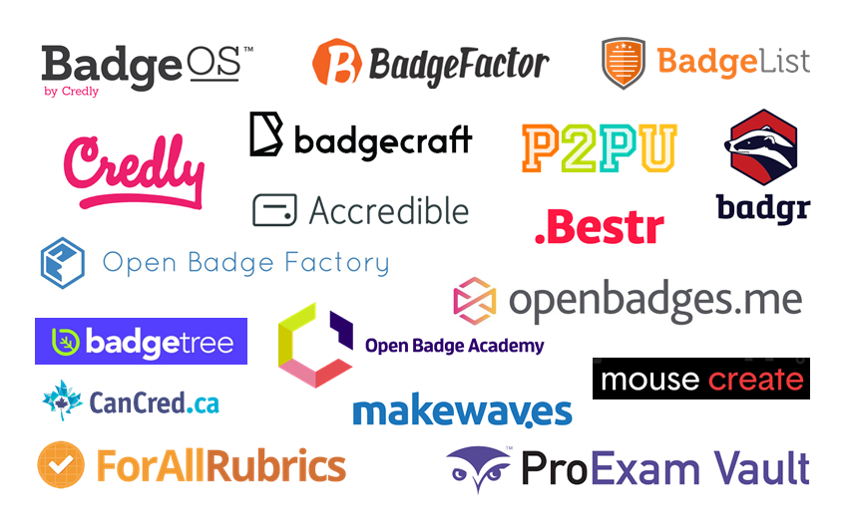
One can also create, issue and verify open badges through one’s own developed platform compliant with the Open Badges specification.
Way Ahead
- Open badges are one of the promising approaches to online credentialing, which can exist alongside and complementarily to traditional credentials. They create ways to recognize more diverse learning pathways and opportunities for lifelong learners and enhance competency-based and competency-focused credentialing, especially in the context of open education.
- Open badges can ensure legitimization of skills and competencies that traditionally are not recognized in university degrees and professional credentials, but are of considerable value in modern society, e.g. the so-called 21st century skills.
- Open badges can facilitate social inclusion of disadvantaged groups such as migrants, refugees or those who are disenfranchised with traditional schooling and face unequal access to education.
- Open badges have become the unofficial global standard, yet the specifications remain free. Experimenting with blockchain technology in education contributes to the development of an infrastructure not only for documenting, storing and managing credentials, but also providing learners with a sustainable record of achievements they can control. It offers an opportunity to pursue implementations of badges as personal currency, which can represent skills and achievements, as well as trust, relationships and reputation.
More on open badges:
Open Badges Open Badges specification Open Badges platforms IMS-certified Open Badges platforms The Cape Town Open Education Declaration

