
Education technology, or ed tech, is a prevalent part of the student and curriculum experience in schools today. This subset of the technology sector is a rapidly growing industry. A recent report calculated the 2024 market size was $163.49 billion with a 2030 projected market size of $348.41 billion. After the COVID-19 pandemic and the heavy reliance on distance learning utilizing laptops and tablets, many schools have transitioned their virtual technology into the physical classroom setting. Students today may have their own school computer or tablet, as well as access to a variety of online learning resources. Some view this as an opportunity to provide individualized learning and prepare students for technological use outside of school. Others have raised concerns that technology negatively impacts students not only in learning, but emotionally and socially.
As the ed tech industry continues to grow and as its presence in schools increases, lawmakers have considered approaches to regulating it. These steps have taken the form of guidance on AI usage, cell phone policies, curriculum, and teacher training requirements. However, the most recent trend is limitations on screen time, especially in early elementary classrooms.
What’s Driving Classroom Screen Time Restrictions?
Much of the rise in legislation surrounding classroom screen time restrictions can be attributed to parental involvement and increasing concern surrounding how ed tech is utilized throughout the school day. Most of these efforts are centered around early elementary aged children. These restrictions come as screen-free parenting is on the rise, limiting children’s use of phones, TVs, tablets, and laptops in their daily lives outside of school. Parents’ main concern is that replacing instructional time from a qualified teacher with an ed tech product will negatively affect their ability to learn and interact with other students, siloing each student into their own technology bubble. More general concerns around screen time usage, including effects on sleep and behavior, have also crept into the debate. While ed tech comes in many different forms, regulating screen time is a blanket measure that places limitations on how long a screen can be used each day.
However, some stakeholders are pushing back against these claims, asserting that not all screen time is created equal, and tailored ed tech usage can be beneficial for students. Stakeholders assert that creating individualized plans meets students where they are, allowing teachers to customize each child’s learning experience. They maintain that it can also boost engagement and improve efficiency for teachers with specific tools to understand students’ capabilities. They argue that to put a limit on screen time restricts a school’s ability to use ed tech as a learning tool, and creates a one-size-fits-all solution, when it’s not applicable.
State Legislative Responses to Screen Time Concerns
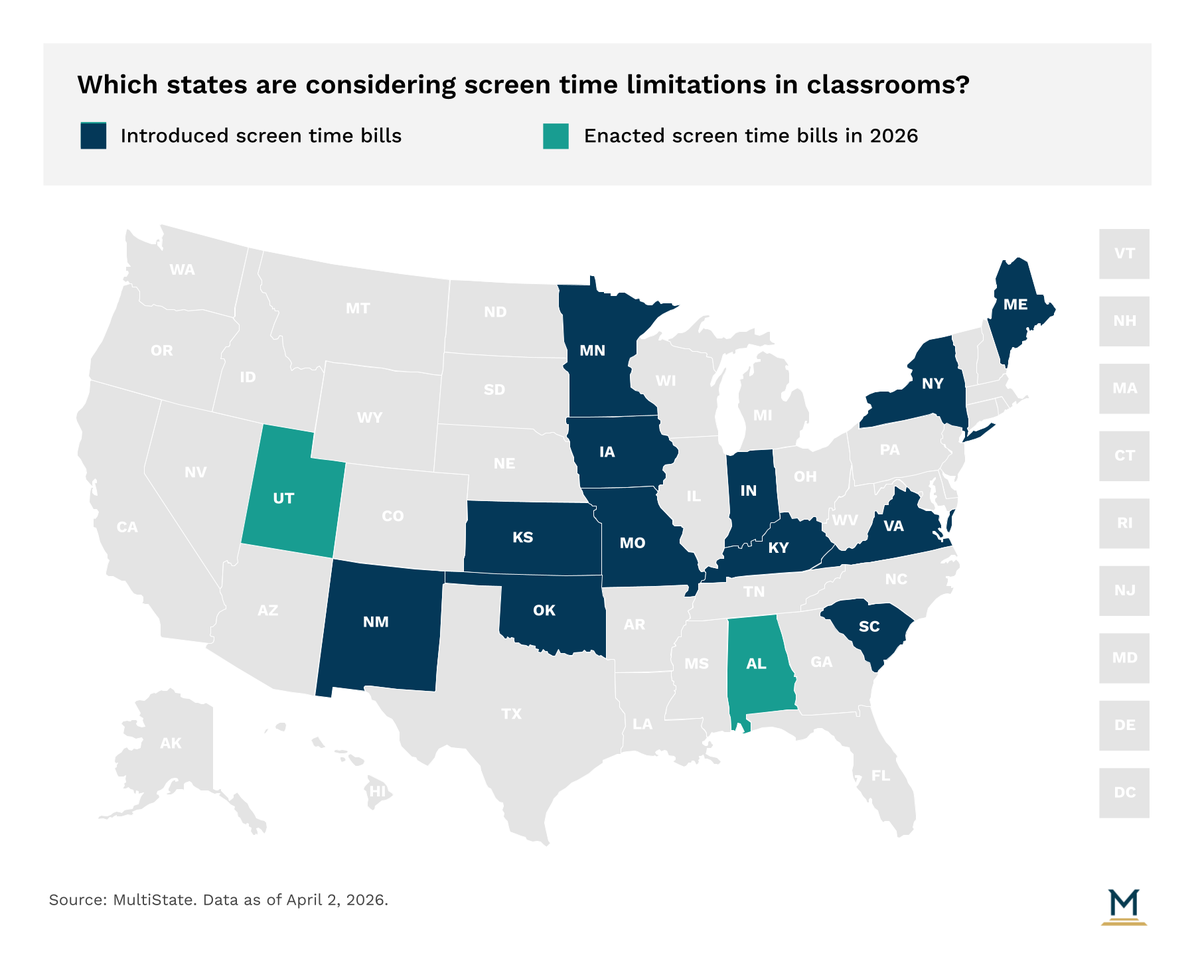
While only twenty bills limiting screen time have been introduced throughout the country, two screen time bills have already been signed into law in Alabama and Utah.
Laws Already in Effect
AL HB 78 was signed on March 4, 2026 and requires the State Department of Human Resources and the State Department of Education to develop screen time standards for early childhood education and training on screen time standards for teachers and staff. This bill has a heavy focus on pre-K students, including limiting screen time in child care settings.
UT HB 273 was signed on March 18, 2026 and requires the State Board of Education to create model policies on the use of technology in public school classrooms by December 1, 2026. The policy must include age-based limits on screen exposure. For grades K-3 this includes prohibiting all screen-time in the classroom except for current K-5 computer science standards and preparation for a standards assessment. In grades 4-6 elementary schools are required to balance the use of instructional technology with instruction through teacher-led, print-based, and analog methods.
Pending Screen Time Legislation Across States
The remaining bills introduced throughout the country are all in various stages of the legislative process, but paint a broad picture of what screen time regulation looks like. IA HF 2451 and OK HB 4358 restrict digital instruction to only 60 minutes per school day in grades K-5. KY SB 318 and MO HB 2230 set the limit at 45 minutes a day. KS SB 350 prohibits all digital devices in grades K-5 and requires all grades to use physical textbooks. ME LD 2052 and NM HM 2 require studies to be conducted on the use of technology in classrooms, including screen time. While there are many approaches to regulating screen time, it’s clear it’s an emerging conversation across the country.
Tracking State Technology and Privacy Legislation
MultiState’s team is actively identifying and tracking Technology and Privacy issues so that businesses and organizations have the information they need to navigate and effectively engage. If your organization would like to further track these or other related issues, please contact us.

