
We are here to offer you the most comprehensive and reliable NCERT Solutions for Class 7 English Unit 7 The Invention of Vita-Wonk, with each and every question of the textbook. These NCERT Solutions for Class 7 have been designed by our subject-matter experts to provide students with solutions that are based on the standards set forth by the board.
The chapter “The Invention of Vita-Wonk” talks about how Vita-Wonk was invented by a scientist named Mr Wonka. At first, he invented Wonka-Vite, which would reduce the age of a person and make him/her younger. It entails a series of events that happened before Mr Wonka could finally invent Vita-Wonk, which can make a person older.
You can also download these NCERT Solutions for Class 7 English in PDF format for free by clicking the link provided below and study anytime, anywhere!
NCERT Solutions for Class 7 English Unit 7 The Invention of Vita Wonk
Download PDF 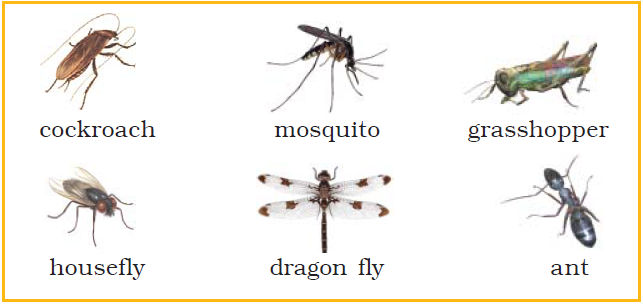
carouselExampleControls111
Access Answers to NCERT Class 7 English Unit 7 The Invention of Vita-Wonk
THE INVENTION OF VITA-WONK
NCERT Solutions Class 7 English – Unit 7
The Invention of Vita-Wonk
Comprehension Check
Answer the following questions:
Question 1. Choose the right answer.
(i) Mr Willy Wonka is
(a) a cook (b) an inventor (c) a manager.
Answer: (b) an inventor
(ii) Wonka-Vite makes people
(a) older (b) younger.
Answer: younger
(iii) Mr Wonka wants to invent a new thing which will make people
(a) younger (b) older.
Answer: (b) older
Question 2. Can anyone’s age be a minus number? What does “minus 87” mean?
Answer: No, someone’s age cannot be a minus number. It is calculated from the day we are born.
Minus 87 means that the person will have to wait for 87 years to take birth.
Question 3: Mr Wonka begins by asking himself two questions. What are they?
(i) What is _____________________?
(ii) What lives _____________________?
Answer: Mr Wonka begins by asking himself two questions. They are:
(i) What is the oldest living thing in the world?
(ii) What lives longer than anything else?
Working with the text
Answer the following questions.
Question 1. (i) What trees does Mr Wonka mention? Which tree does he say lives the longest?
(ii) How long does this tree live? Where can you find it?
Answer: (i) Mr Wonka mentions the following trees:
- Douglas fir
- Oak
- Cedar
- Bristlecone pine
He says that the Bristlecone pine lives the longest.
(ii) This tree has lived for over 4000 years. It can be found upon the slopes of Wheeler Peak in Nevada, U.S.A.
Question 2. How many of the oldest living things can you remember from Mr Wonka’s list? (Don’t look back at the story!) Do you think all these things really exist, or are some of them purely imaginary?
Answer: Here are the oldest living things that are enlisted by Mr Wonka:
A 4000-year-old bristlecone pine
A 168-year-old Russian farmer
A 200-year-old tortoise
A 51-year-old horse
A 36-year-old cat
A 207-year-old giant rat
A 97-year-old grimalkin
A 700-year-old cattalo
A 36-year-old-flea
I think most of them exist, while some might be purely imaginary.
Question 3. Why does Mr Wonka collect items from the oldest things? Do you think this is the right way to begin his invention?
Answer: Mr Wonka collects items from the oldest things because he had to invent an item that can make people older.
I think researching the oldest things is still a good idea as it can give him an insight into what might be the reason behind their long life. But, collecting little things from such species is not a great idea to begin his invention.
Question 4. What happens to the volunteer who swallows four drops of the new invention? What is the name of the invention?
Answer: The volunteer began to wrinkle and shrivel up all over. His hair started to drop off and his teeth started to fall out. He suddenly became a seventy-five year-old man!
The name of the invention was Vita-Wonk.
Working with language
Question 1. What do you call these insects in your language?
Add to this list the names of some insects common in your area.
Answer: (Write the names of these insects as spoken in your language.)
Some other insects that are found commonly in our area are: bee, spider, lizard, etc.
Question 2: Fill in the blanks in the recipe given below with words from the box.
shred cooker times tomatoes half onion oil
Easy Palak-Dal
INGREDIENTS
• One ________
• One cup dal
• Two thin green chillies
• ________ a teaspoon red chilli powder
• Eight small bunches of palak
• Two ________
• Salt to taste
Wash and cut the vegetables; ________ the palak. Put everything in a pressure ________. Let the cooker whistle three ________, then switch it off. Fry a few cumin seeds in ________ and add to the palak-dal.
Answer:
• One onion
• One cup dal
• Two thin green chillies
• Half a teaspoon red chilli powder
• Eight small bunches of palak
• Two tomatoes
• Salt to taste
Wash and cut the vegetables; shred the palak. Put everything in a pressure cooker. Let the cooker whistle three times, then switch it off. Fry a few cumin seeds in oil and add to the palak-dal.
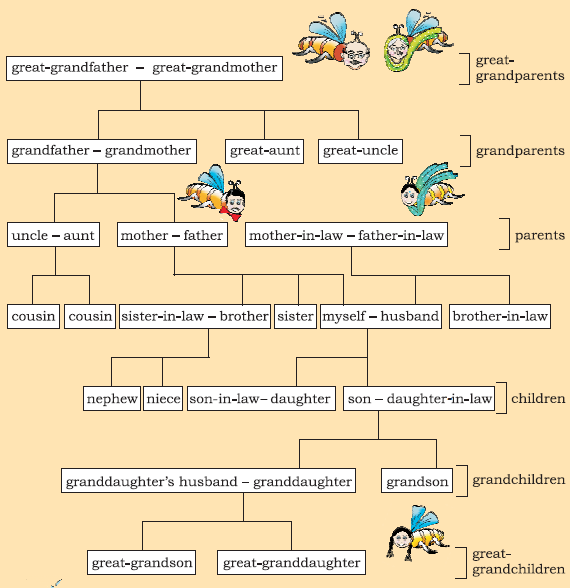
Question 3: A ‘family tree’ is a diagram that shows the relationship between the different members of a family. Fill in the family tree below with names, ages, and other details you think are relevant (you may even stick photographs, if you have them). Put your family trees up in the class.
Answer: Do it yourself.
Speaking
Question 1. Using Do for Emphasis
Charlie asks, “What did happen?”
This is a way of asking the question “What happened?” with emphasis.
Given below are a few emphatic utterances. Say them to your partner. Let your partner repeat your utterance without the emphasis. Your partner may also add something to show she/he disagrees with you.
YOU: I did study.
PARTNER: You studied? I don’t believe you. Look at your marks!
YOU: I did go there.
PARTNER: You went there? Then…
YOU: I do play games.
PARTNER: …
YOU: He does read his books.
PARTNER: …
YOU: You do say the most unbelievable things!
PARTNER: …
YOU: The earth does spin around.
PARTNER: …
YOU: We all do want you to come with us.
PARTNER: …
YOU: Who does know how to cook?
PARTNER: …
YOU: I do believe that man is a thief.
PARTNER: …
Answer: YOU: I did go there.
PARTNER: You went there? Then how was I unable to find you there?
YOU: I do play games.
PARTNER: You play games? Then why don’t you participate in them in the school?
YOU: He does read his books.
PARTNER: He reads his books? But he is never able to answer the questions correctly.
YOU: You do say the most unbelievable things!
PARTNER: I say the most unbelievable things? Why do you feel so?
YOU: The earth does spin around.
PARTNER: The earth spins around? How can you be so sure?
YOU: We all do want you to come with us.
PARTNER: You want me to come with you? Then why did not you guys call me earlier?
YOU: Who does know how to cook?
PARTNER: I do not. But can’t say about my elder sister. I think she knows how to cook.
YOU: I do believe that man is a thief.
PARTNER: You believe that man is a thief? What makes you think so?
Writing
Question 1. (i) Make a list of the trees Mr Wonka mentions. Where do these trees grow? Try to find out from an encyclopedia. Write a short paragraph about two or three of these trees.
(ii) Name some large trees commonly found in your area. Find out something about them (How old are they? Who planted them? Do birds eat their fruit?), and write two or three sentences about each one of them.
Answer: (i) Mr Wonka mentions the following trees:
- Douglas fir
- Oak
- Cedar
- Bristlecone pine
Douglas fir is found in coastal regions from west-central British Columbia southward to central California.
Oak is found in cool temperate to tropical latitudes in Asia and America.
We can find Cedar in the mountains of the western Himalayas and the Mediterranean region.
Bristlecone Pines are found in the higher mountains of the southwest United States. There are such bristlecone pine trees which are over 4000 years old.
(ii) Some large trees found around my area are:
Eucalyptus trees, Neem trees, Peepal trees and Banyan trees.
Eucalyptus trees are largely found in my area. They are used to prepare eucalyptus oil that has medicinal uses.
Peepal and Banyan are worshipped. Some of them have existed for more than 150 years.
The Neem tree in front of my house was planted by my grandmother 50 years back. It is a huge tree now.
Question 2. Find out something interesting about age, or growing old, and write a paragraph about it. Following are a few topics, suggested as examples.
• The age profile of a country’s population — does it have more young people than old people or vice versa? What are the consequences of this?
• How can we tell how old a tree, a horse, or a rock is?
• What is the ‘life expectancy’ of various living things and various populations (how long can they reasonably expect to live)?
Answer: The age of any living thing is calculated from the day it is born. It determines how much it has lived till date. There are some countries where more people are of old age rather than young.
For instance, in countries like Italy where there are more old people rather than young people, whereas India is a country where the number of youth is higher.
The age of a tree can be calculated by counting the number of rings in its trunk. The carbon dating process can be used to find the age of a horse, a rock, etc.
Also, explore – NCERT Solutions

